Santee sets priorities for federal community development funds
Infrastructure upgrades receive largest share as council weighs funding for local nonprofits
By Gary Warth
Feb. 25
SANTEE — Infrastructure improvements will receive the largest share of Santee’s anticipated $349,000 in federal Community Development Block Grant funds, while local nonprofit programs will compete for a much smaller portion under funding priorities approved by the City Council.
Council members adopted the preliminary spending plan at a recent meeting as part of the city’s annual process for allocating federal housing and community development funds.
Most of the funding will go toward infrastructure projects and administrative costs, which council members unanimously approved at a recent City Council meeting. Installation of ADA-compliant pedestrian ramps is expected to receive the largest allocation — $227,000 this year, compared with $245,000 last year.
But deciding how to distribute the limited funds among nonprofit programs sparked the most discussion among council members.
In the end, the Santee Food Bank received the largest allocation at $27,410, about the same as last year but roughly $7,600 less than requested.
A proposed pilot program aimed at providing addiction recovery services to help prevent homelessness received no funding, with council members instead choosing to support local programs that had received funding in previous years. None of the organizations received their full requested amounts.
The council first heard public testimony from applicants on Feb. 11 and voted on funding priorities at its Feb. 25 meeting.
The city must submit an Annual Action Plan outlining funding priorities to the U.S. Department of Housing and Urban Development (HUD) by May 15. The plan will be available for public review at a future meeting before submission.
The estimated $349,000 allocation reflects the average amount the city has received in past years and represents an expected decrease of about 7%. Nonprofit funding requests included:
- East County Transitional Living Center — $56,000
- ElderHelp of San Diego — $7,000
- Meals on Wheels — $5,000
- Recovery & Beyond — $25,000
- Santee Food Bank — $35,000
- Santee Santas — $5,000
- Voices for Children — $10,000
Total requests amounted to $143,000, but staff projected only $52,410 would be available for public services.
Two representatives from Recovery & Beyond were the only speakers to address the council. They described the proposed program as a way to fill a gap between homelessness and placement in a treatment facility.
One presenter said some Santee residents seeking treatment are currently on waiting lists, putting them at risk of relapse and potentially returning to homelessness. Even without the full $25,000 requested, she said the pilot program would still launch but would serve fewer people.
Council members ultimately prioritized established programs over the new initiative. In initial discussions, Recovery & Beyond received only a $5,000 allocation from Mayor John Minto and $1,000 from Councilmember Ronn Hall.
Council members unanimously agreed to allocate $5,000 to Voices for Children, half of the amount requested and slightly less than last year’s allocation.
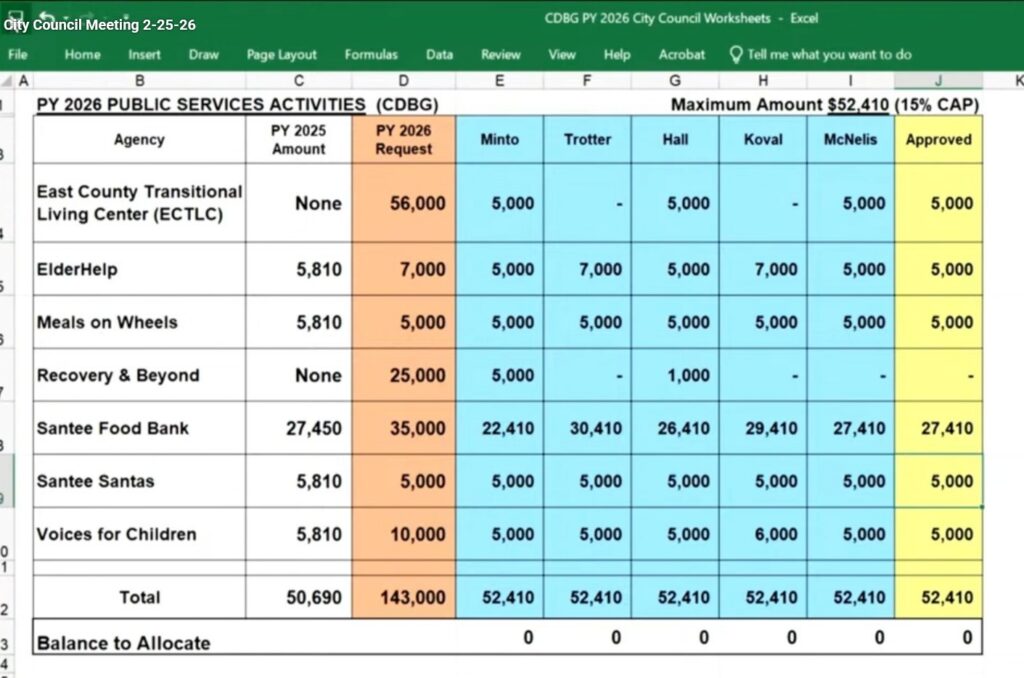
There also was consensus among at least three council members to allocate $5,000 each to ElderHelp, Meals on Wheels, East County Transitional Living Center and Santee Santas, which provides food, toys and holiday support for low-income families and seniors.
Councilmembers Dustin Trotter and Laura Koval initially voted to allocate no funding to East County Transitional Living Center.
Koval said she opposed allocating CDBG funds to the center because the city already directs significant resources toward homelessness programs through other funding sources. Trotter said he shared that perspective.
In last year’s allocations, Meals on Wheels and Santee Santas each received the full $5,000 requested. Crisis House and ElderHelp received $5,000 each, the Santee Food Bank received $23,600 and Voices for Children received $5,000.
Santee’s funding decisions come as cities across San Diego County continue balancing infrastructure needs with investments in social services and homelessness prevention, priorities that increasingly intersect as housing costs and economic pressures affect more residents.
