Alpha Project leader blends compassion, education and discipline in supportive housing role
By Gary Warth
March 12, 2026
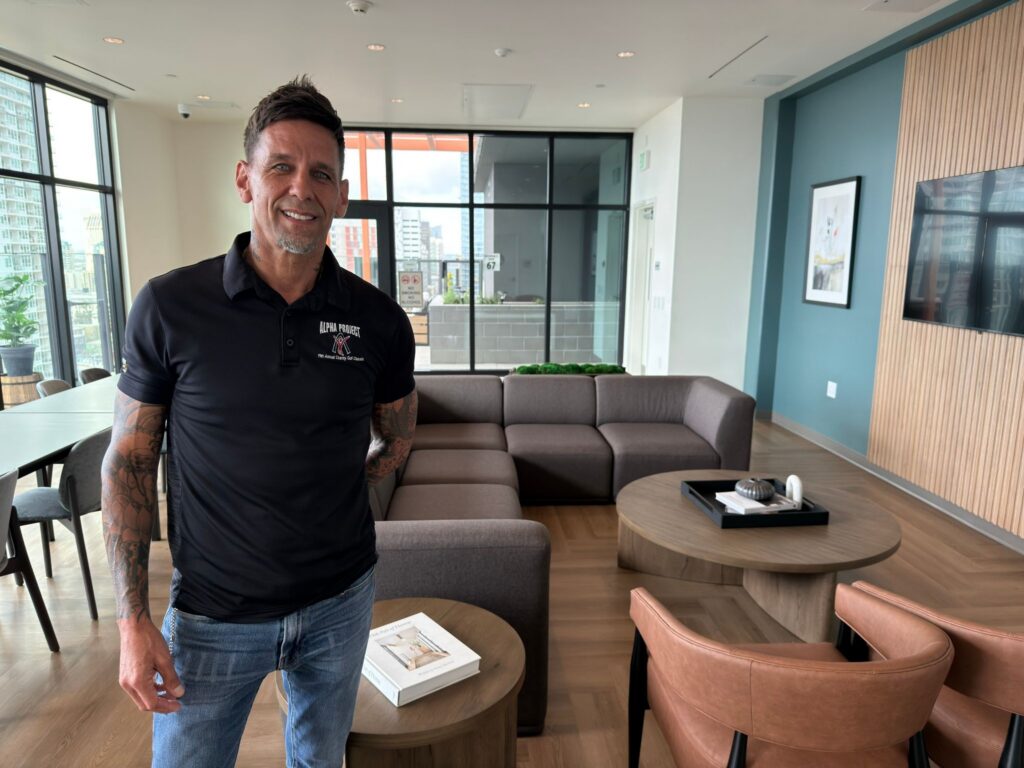
SAN DIEGO — Travis Larson’s title at Alpha Project is senior director of supportive housing, but his approach to the job reflects a mix of educator, counselor and coach.
Before joining the nonprofit in 2009, Larson spent a decade as a high school teacher and earned a master’s degree in education. Today, he uses that background to train staff in trauma-informed care, helping them better understand the people they serve.
He also holds a master’s degree in marriage and family therapy, which he credits for shaping the communication skills he relies on daily.
“Teaching is human services at its core,” Larson said. “I’ve always been very interested in the human experience.”
That perspective carries into his current role overseeing five Alpha Project properties, including Harrington Heights, a 15-story downtown development that opened in October with 273 units serving a mix of low-income residents, veterans, people with disabilities and individuals in permanent supportive housing.
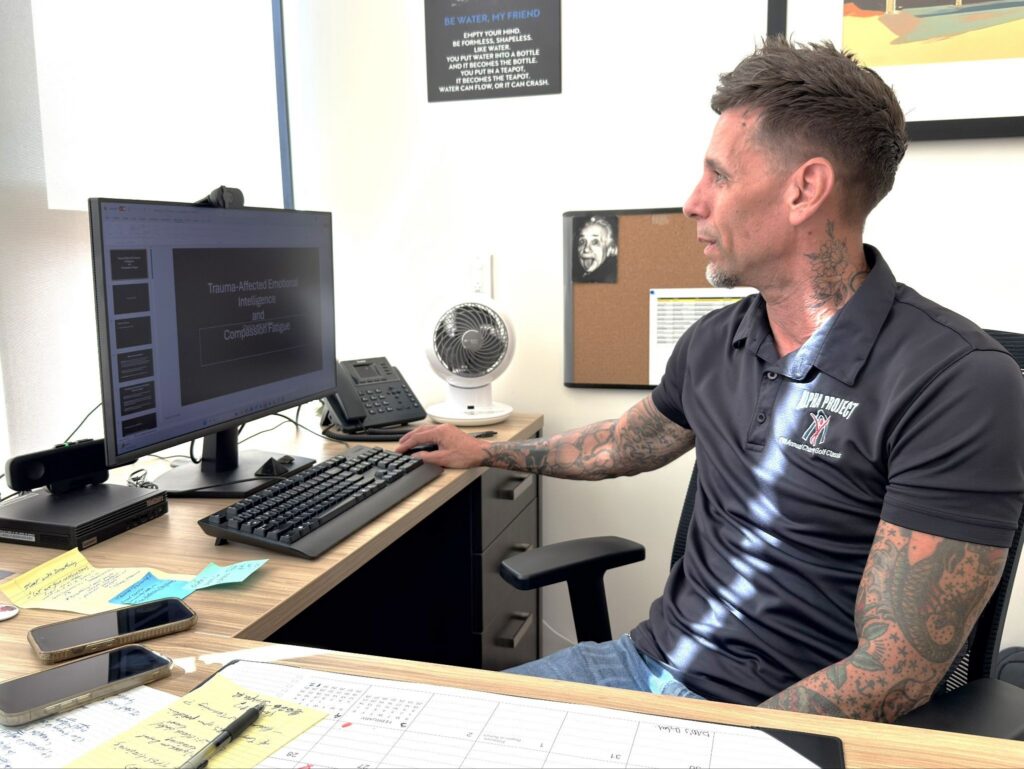
Larson’s office reflects the influences that shape his leadership style — from Brazilian Jiu Jitsu, which he has practiced for years, to quotes from Bruce Lee and Martin Luther King Jr., to books on mindfulness and purpose.

But his path to the field was not linear.
After years in education — including teaching and coaching at Torrey Pines High School and in Irvine — Larson began looking for a change amid uncertainty in school funding and staffing.
That search led him to Alpha Project’s Casa Raphael recovery program in Vista, where a graduation ceremony for clients left a lasting impression.
“I was just so impressed,” he said. “It made me start thinking about what I wanted to do next.”
He reached out to Alpha Project founder and CEO Bob McElroy and was soon hired to help launch a program aimed at moving people directly from the street into housing with supportive services.
“We’d bring people straight off the street into housing and surround them with services,” Larson said. “There was a real sense of urgency — almost a triage approach.”
Over time, Larson rose through the organization into his current leadership role, where he emphasizes adaptability, humility and continuous learning.
A key influence has been the work of homelessness expert Iain De Jong, whose leadership training Larson attended through the Regional Task Force on Homelessness.
One lesson stood out: “You can’t lead from ego.”
For Larson, that means being willing to acknowledge mistakes, adjust strategies and create a work environment where staff feel safe to try new approaches.
“If something isn’t working, you have to be able to look in the mirror and change course,” he said.
That mindset also shapes how he approaches public perceptions of homelessness — many of which he believes are based on limited or inaccurate assumptions.
“People often rely on one or two experiences or something they’ve heard,” Larson said. “But that leaves out a huge portion of the population.”
He points to factors like the absence of family support systems — something he says is often overlooked.
“I have a strong support system,” Larson said. “A lot of people we meet don’t have that. And that makes a huge difference.”
He also challenges the common belief that people experiencing homelessness simply refuse help.
“There are cases where people decline services,” he said. “But more often, it means we need to rethink how we’re engaging. If it’s not working, we need to adjust.”
That persistence, he said, is critical.
Recalling a leadership session, Larson described an outreach worker frustrated after more than a dozen unsuccessful attempts to connect with someone on the street.
“The answer is the next time,” Larson said. “It might be the 14th time that makes the difference.”
Larson’s work is part of a broader regional effort to expand supportive housing and services as San Diego works to move more people from the streets into stability.
