Chula Vista delays decision on Wakeland affordable housing project
By Gary Warth
June 2, 2026
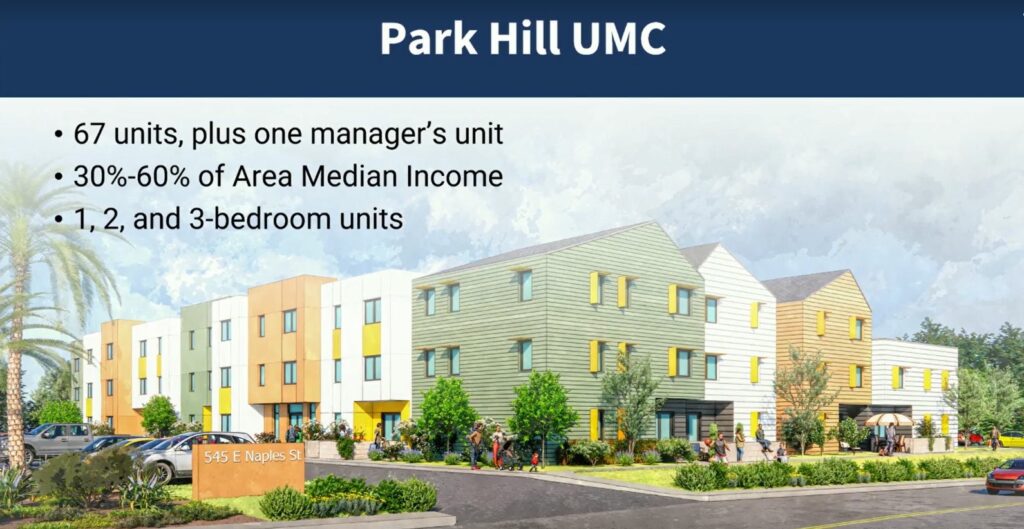
Funding for a three-story, 68-room affordable housing project planned in Chula Vista is in jeopardy after members of the City Council and the community raised concerns about its size and impact on a neighborhood.
A City Council split 3-2 on June 2 in a vote to hold off on allocating up to $4 million for the project planned by the nonprofit Wakeland Housing and Development Corporation on property owned by Park Hill Methodist Church at 545 East Naples St.
The council instead voted to continue discussion of the project to their June 16 meeting, which will give Wakeland time to hold a public meeting at the church to address community concerns. The housing would be built on a site now used as a baseball field across the street from Greg Rogers Elementary School and Greg Rogers Park.
The council is facing a fast-approaching deadline to make a decision on how to spend the money.
Of the $4 million, $3 million is from the city Housing Authority’s Low-and Moderate-Income Housing Asset fund, which is money left over from the city’s redevelopment agency that was dissolved by state legislation in 2012.
The fund is above the amount allowed under a state formula, triggering a three-year deadline to spend the money on affordable housing or otherwise return it to the state. The three-year mark will be hit at the end of June
Mayor John McCann voted against continuing the item and had suggested funding another project, which he said could be done in time to beat the deadline.
Councilmember Jose Preciado supported funding the Wakeland project and also voted against continuing the item.
Discussion of the item had previously been continued from the council’s May 19 meeting after hearing community concerns about parking, privacy and drainage.
The staff report presented to the council said the draining issues would be addressed before the project is approved for construction and the parking and privacy issues also would be addressed by Wakeland as the design proceeds. Construction is not expected to start for two or three years.
The city released a Notice of Funding Opportunity in November and received an application from Wakeland and another for a 101-unit project by Eden Housing at 750 E St.
McCann said he would like to fund the Eden Housing project instead after talking to more than 300 residents who objected to the Wakeland project planned for their neighborhood.
“We need to listen to the people,” he said. “We need to understand that this would be a very, very challenging project that would increase traffic congestion.
“It would eliminate so much parking on the side streets,” he continued. “It would be too dense and there would be major issues with this project because it wasn’t planned properly.”
The $4 million from the city would cover 7% of the estimated $53.8 million construction cost of the Wakeland project, and the developer has not yet raised the additional funds.
The project would be allowed on church property under the Affordable Housing on Faith and Higher Education Lands Act, a state law from 2023 that allows religious institutions and nonprofit colleges to bypass traditional local zoning restrictions to build 100% affordable housing on their property.
Also known as “Yes in God’s Backyard,” the act streamlines the approval process for qualified projects by avoiding the lengthy and expensive process of rezoning.
