Encinitas delays application for Encampment Resolution Fund
By Gary Warth
June 10, 2026
The Encinitas City Council is considering applying for a state Encampment Resolution Fund, but first wants the wording of the application to downplay the housing-first approach.
Council members heard a presentation about an opportunity to apply for a $3.9 million state Encampment Resolution Fund grant at its June 10 meeting, and several officials appeared open to the idea of receiving the funds to expand much of the work the city already is doing to address homelessness.
The state program has been used locally to close encampments and move people into housing in San Diego, Lemon Grove and jointly in Carlsbad and Oceanside.
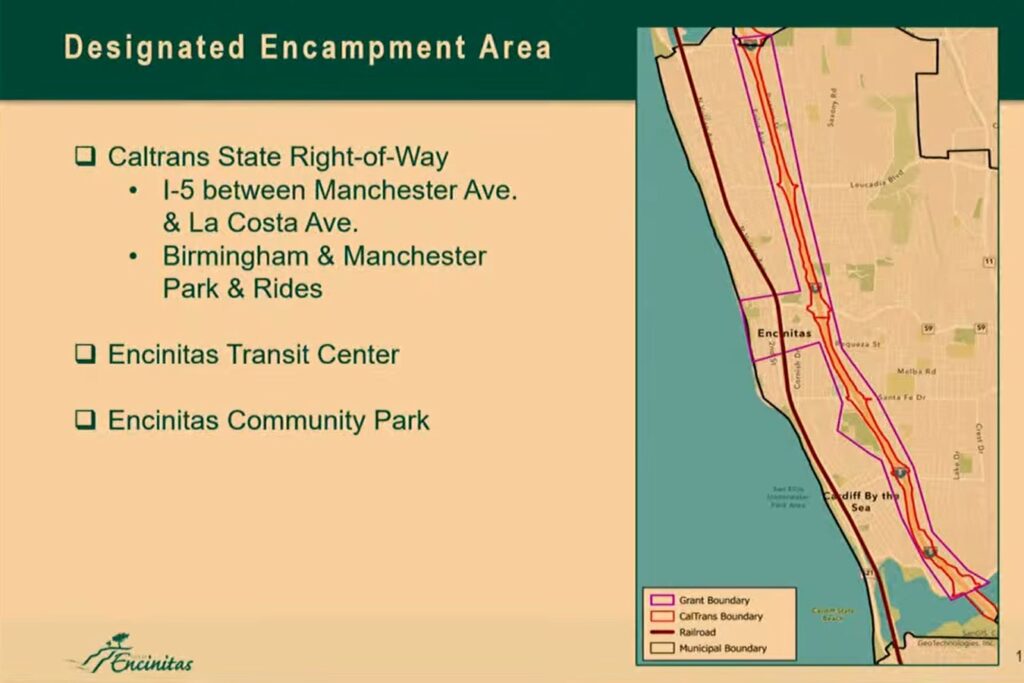
As a state program, the Encinitas ERF would focus on the Caltrans right-of-way between Manchester and La Costa avenues and also would include the Manchester and Birmingham Drive Park-and-Rides and the Encinitas Transit Center and Community Park.
Distrust in the state and a negative perception of housing first, however, resulted in Encinitas council members delaying a decision on the application until their June 24 meeting, just six days before the June 30 deadline to submit applications.
The discussion also came 18 months after then-City Manager Pamela Antil withdrew a $2.9 million ERF application the previous City Council had agreed to submit. The current council at the time was not informed about the withdrawal, which was made two weeks after the November 2024 election and one day before Antil left her position.
During the June 10 meeting, Encinitas Homeless Program Director Crystal Pugh presented the council with details of the application for Round 5 of the ERF, which she said differed from previous funding rounds because it does not require immediate placement into permanent housing but offers options that include placement in interim housing, recovery programs, transitional housing or family reunification as a pathway to permanent housing.
The new funding round gives applicants some flexibility in following housing first, an approach that traditionally has offered housing as a first step and without mandated treatment because it creates a stable environment that is more likely to have long-term positive outcomes.
While Round 5 has options that do not require immediate housing, Pugh said the grant still requires a housing-first approach, meaning people will be on a pathway to housing.
“It does not mean everyone must be placed into permanent housing right away, and it is not a housing-only model,” she said.
Pugh further explained that housing-first does not require individuals with active substance use to be placed directly into housing and it does not remove accountability for tenants who are housed and will have to follow standard lease agreements.
Encinitas Mayor Bruce Ehlers and some council members said they were uncomfortable with the wording in the application because of its references to housing-first.
“Housing first has failed,” he said. “In the extreme sense of housing first, it’s putting a drug addict in a rooming house together with a bunch of other drug addicts. Everything I’ve read, whether you read ‘San Fransicko’ or any other article on it or a book, it doesn’t appear, in my opinion, to be working.”
Ehlers was referring to the 2021 book, “San Fransicko: Why Progressives Ruin Cities” by Michael Shellenberger. The book was praised by some for its critique of an approach that funds housing without addressing mental illness and addictions.
Housing advocates, however, were highly critical of the book’s methodology and conclusions, with the Coalition on Homelessness publishing a paper that rebutted many of the book’s claims and noted that many cities have proven housing-first effective.
Council members will see a revised version of the application in the agenda for the June 24 meeting following Ehler’s motion to “soften” the wording about housing first.
“I have to admit I’m not comfortable with the wording in that section where it says ‘All services and housing pathways are fully housing-first,” he said. “Do we have to say that? Can we say something more along the lines of what the presentation says, that our response will include housing-first where it is necessary, but we anticipate getting people onto the pathway and they won’t go into housing directly.”
Five members of the public spoke against the application, and the four people in support included John Van Cleef, chief executive officer the Community Resource Center in Encinitas.
Van Cleef said the Community Resource Center has been working with the cities of Carlsbad and Oceanside on their ERF project, and 91% of the formerly homeless people in the program have remained housed, with many receiving case management, mental health services, detox services, psychiatric support and other help.
“It works,” he said. “Helping people move from outside to inside and providing supportive services is meaningful.”
The application proposed by city staff calls for 100 homeless people to be served over four years, with 20 going into permanent housing and others going into other housing options.
The San Diego Rescue Mission is already contracted to provide homeless outreach services for the city and would hire six additional staff members with the ERF funding.
