City Council hears update on Oceanside homeless services
Hundreds of homeless people in Oceanside were connected to services and dozens have moved into permanent housing in the past year, City Council members heard in a presentation at their Sept. 2 meeting.
“One of the key messages we hope to demonstrate tonight is that addressing homelessness requires a coordinated system,” Homeless Services Manager Tameka Tates told council members. “It is not the responsibility of any one program or department.”
Tates noted that the library, Police Department, Fire Department, various development services in the city as well as Housing and Neighborhood Services in the City Manager’s office all played a role in the city’s approach to solving homelessness.
Council members also heard how the half-cent sales tax Measure X has funded housing and services for many people in Oceanside, and they received an update on a new project that will house individuals, families and veterans who are facing or at-risk of homelessness.
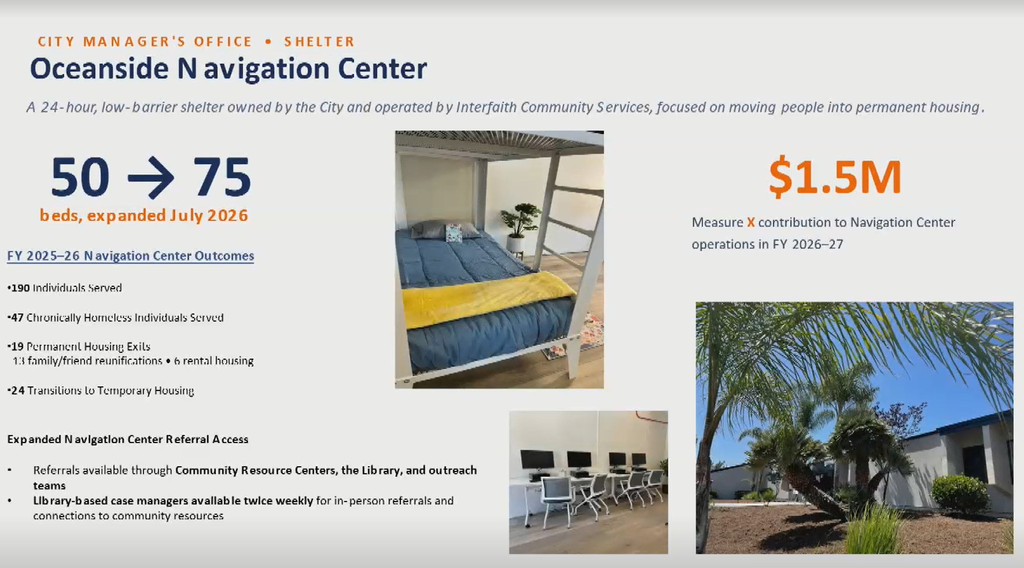
Among the larger city efforts, the Oceanside Navigation Center run by Interfaith Community Services received $1.5 million in fiscal year 2026/27 and has been expanded from 50 to 75 beds.
During that fiscal year, the shelter served 190 individuals, including 47 who were experiencing chronic homelessness, Tates said. Of those served, 19 people transitioned to permanent housing, including 13 through reunification with family members or friends. Another six transitioned to rental housing and another 24 transitioned to other temporary settings.
In a new move, referrals to the shelter now are made at city community resource centers, libraries and by outreach teams.
The city’s safe parking program operated by Dreams for Change moved to a new location this year and is being expanded from 25 to 50 vehicles a night, Tates said.
The lot is open 6 p.m. to 6 a.m. daily and this year served 130 individuals, including 20 children, across 94 households, she said.
Of the people who used the program, 11 transitioned to permanent housing, 12 moved in temporarily with family members or friends, and 13 went into an emergency shelter, Tates said.
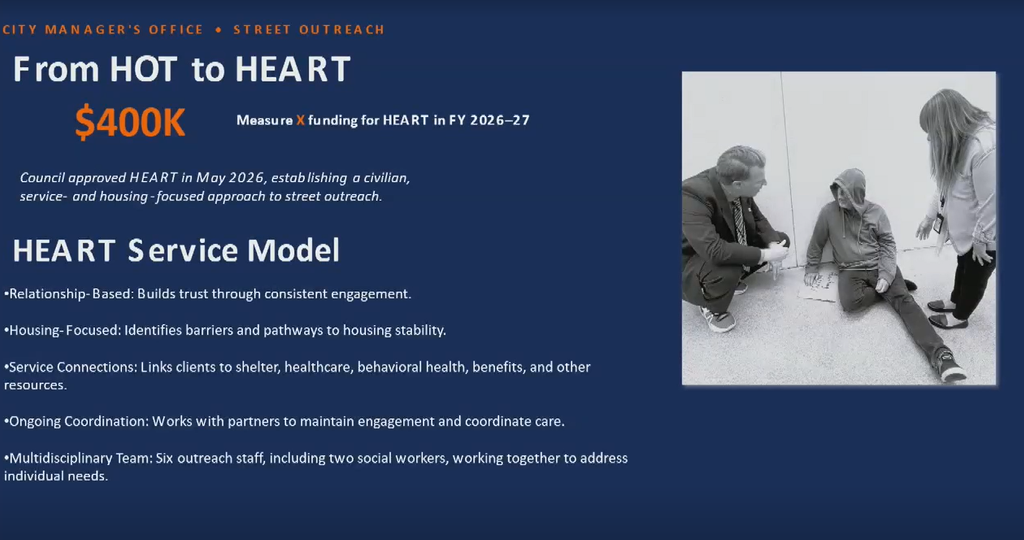
In a significant change to Oceanside’s approach to solving unsheltered homelessness, the City Council in May approved the creation of the civilian-led Homeless Evaluation Assistance and Resource Team (HEART), a departure from the police-led Homeless Outreach Team.
HEART will include six outreach workers and two social workers who will focus on connecting homeless people to shelter, housing, health care, behavioral health services and other resources, Tates said.
The city uses a by-name list to keep track of people who have been contacted by outreach workers and referred to various services. Tates said the list shows 526 unduplicated individuals accessed city-funded homeless services, including 324 who were served through outreach, 190 referred to the Navigation Center and 130 who used the safe parking program.
“The city’s by-name list helps us understand who we are serving, what their needs are and how we can better coordinate services,” Tates said. “I found 159 were served by more than one program, which really highlights the importance of coordination.”
The list also shows nine people interacted with all three service areas, she said.
“Through monthly case counseling, our outreach team and community partners can review individual needs and barriers, coordinate services and track next steps toward housing stability,” Tates said. “The ultimate goal is to make sure we’re working together and not operating in silos.”
Tates said the Measure X half-cent sales tax approved by voters in 2018 and renewed in 2024 generated about $2.98 million in homeless services this past fiscal year and will continue to create city revenue through April 2036.
The tax brought in $1.5 million for the Navigation Center, $400,000 for HEART, $375,000 for homeless diversion and prevention and $330,000 for safe parking. The balance funded two social workers, homeless response coordination staff members and other expenses.
Oceanside Management Analyst Salvador Roman also spoke at the meeting and told council members about the city’s prevention, resolution and diversion efforts.
Ramon said the city has a little under 1,400 vouchers in use, with 44% for seniors 62 and older, and 48% for people with a disability. The average annual income of the recipients is $25,974, and 64% rely on Social Security, SSI or a pension as their primary income source, Roman said.
Four new residential projects are coming online that will add 545 more units in the city, including units for seniors, singles, couples, families and veterans who are homeless or at risk of homelessness. The projects are supported with a $10.3 million investment from the city and 124 project-based vouchers.
“At its core, fundamentally the issue of homelessness is a housing issue,“ Ramon said. “I think it’s important to recognize that. Whether they have other needs and they may require ongoing stability, the core issue will always remain addressing the housing need.”
Ramon said Measure X provided $233,000 for bridge/transitional housing, with 87% of clients transitioning into permanent housing.
The city’s prevention and diversion efforts kept people housed through a $3 million investment in tenant-based rental assistance. Measure X , local grants and state grants through RTFH provided $375,000 for rapid, short-term assistance like security deposits, credit-check fees, and first and last month’s rent to keep people from falling into homelessness, Ramon said, adding that 300 families have been helped.
Ramon said he was personally most proud of the success the city has had in its permanent supportive housing projects. In particular, Greenbrier Village has provided 60 units for people who were homeless or at-risk of homelessness, including nine units for adults with disabilities, five units for veterans and three units for youths aging out of the foster system.
In the future, Coast Villas will be another residential project that will bring more units and services for residents. That project will provide 56 units for seniors, 15 for veterans and 12 for people with serious mental illness, Ramon said.
Oceanside and Carlsbad together secured an $11.3 million state Encampment Resolution Fund grant, which has a target of housing 196 people by June 2027, Ramon said. So far 80 people have been permanently housed, with the first area targeted a large encampment along Buena Creek behind the Hobby Lobby off of College Boulevard.
The update on homeless services was an information-only item before the City Council and was not discussed by council members after the presentation.
