Oceanside receives $3 million from state for cabin village
By Gary Warth
Oct. 8, 2026
Oceanside is planning to expand its homeless shelter capacity with the addition of cabins that will be placed next to its navigation center, and the city has received $3 million in state funds to get the project off the ground.
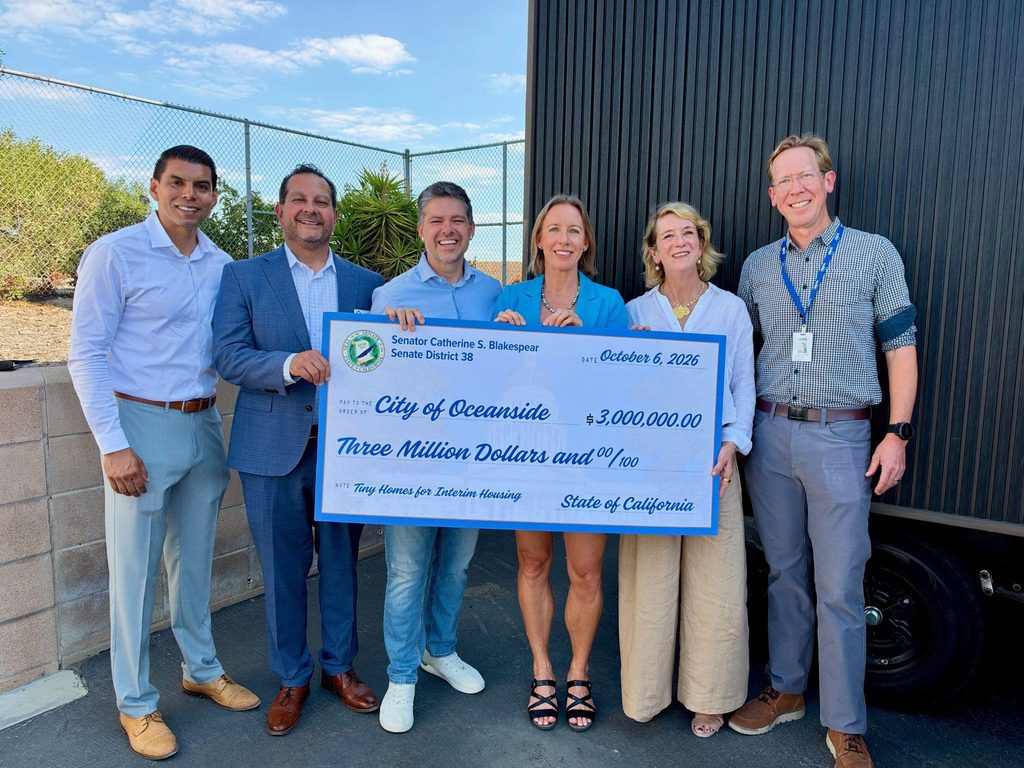
State Sen. Catherine Blakespear, D-Encinitas, secured funds for the cabins and presented a check to city officials Oct. 6.
“I was excited to advocate for this project and secure funding for it because I know how important and impactful interim housing is,” Blakespear said. “Other cities have shown that by building small individual shelters at scale, they can dramatically reduce the number of people forced to live unsheltered on their streets. Congratulations to Oceanside for doing the hard work to make this happen.”
Oceanside Deputy Mayor Eric Joyce said the $3 million will be used to create 20 to 25 cabins on open city-owned land next to the 75-bed navigation center on Oceanside Boulevard.
“It’s still preliminary,” he said. “We have a broad scope plan of what it will look like.”
Joyce said the cabins could be used by homeless seniors, and he hoped they would be in place before the predicted El Niño storms hit this winter.
The concept of using small cabins for shelters is not new but still is rare in San Diego County. El Cajon has a village of 10 cabins for women and children at Meridian Baptist Church, Chula Vista has a village of 65 pallet shelters, and 70 sleeping cabins are planned on state property in Lemon Grove.
With many homeless people declining to accept offers to stay in large congregate shelters that have rows of bunk beds, pallet shelters and emergency sleeping cabins that provide privacy and security are seen as promising alternatives to get people off the streets.
Joyce said Oceanside city officials have been collaborating on their plan with the San Francisco-based nonprofit DignityMoves, which develops modular interim housing for homeless people.
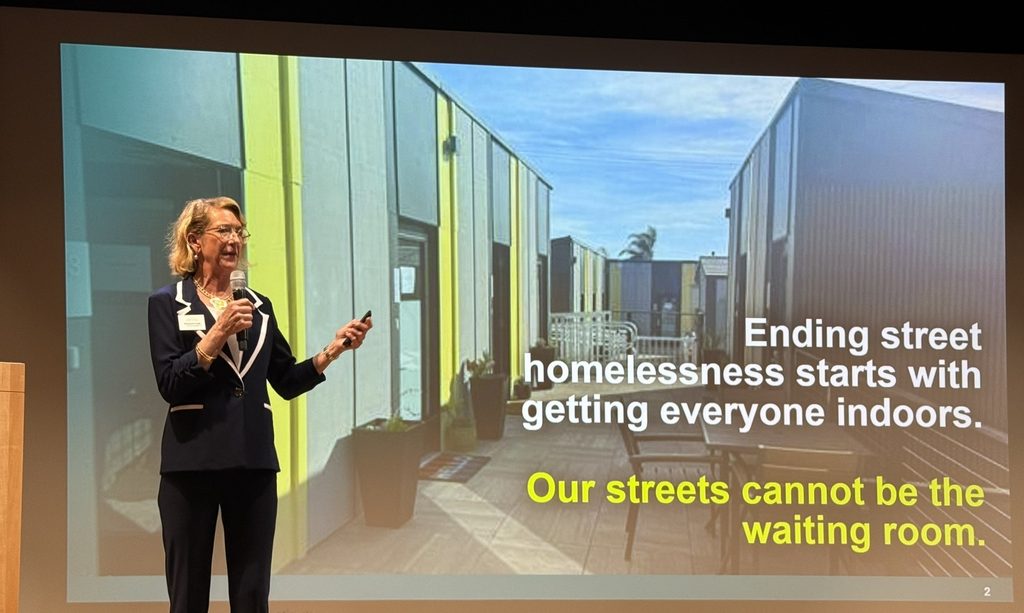
Examples of the type of cabins DignityMoves promotes were displayed at the Oct. 6 press conference. DignityMoves CEO Elizabeth Funk attended the conference and spoke the next day at the Homeless Summit organized by Blakespear in Carlsbad. “The ultimate goal in our homeless system is to get people in permanent housing,” she said. “But in the meantime our streets can’t be the waiting room. In fact, our streets are the most dangerous and debilitating waiting room we could create.”
Funk described a city’s typical homeless response as offering either a shelter, which provides only a temporary stay, or permanent housing, which is costly and may take years to build.
“There is this enormous gap in between,” she said. “So we started thinking, how could we close that gap on one end? How could we make shelter more effective? Let it be a place where people are willing to stay and come for a while and feel safe. How could we make it a place where maybe they can actually start to get well rather than just stay dry?”
Funk said the answer is to create cottage communities as interim housing that offer longer stays than shelters but are much less expensive than permanent homes.
The modular structures also are faster to install, she said, and so far the nonprofit has created 15 communities across the state and has more on the way.
Funk said DignityMoves has found acceptance in neighborhoods by vowing to accept only people who are in encampments in the area where the cabins will be installed, and then bar encampments from returning to the area.
Besides clearing neighborhoods of encampments and giving homeless people a safer environment, Funk said there are other additional benefits for cabin communities.
Fiscal conservatives will appreciate that an estimated $40,000 annual cost to house a person in a cabin is half the estimated cost a city pays in emergency services, debris removal and other expenses for each person on the street, she said, adding that the threat of wildfires from encampments also will be reduced.
She also noted that San Francisco has recognized cabin communities as the right model for recovery programs.
Overall, Funk argued that cabin communities make fiscal sense for cities while also providing the stability needed to keep a homeless person from spiraling into long-term, chronic homelessness.
