Brother Batie brings lived experience, business background to YMCA programs
May 19
By Gary Warth
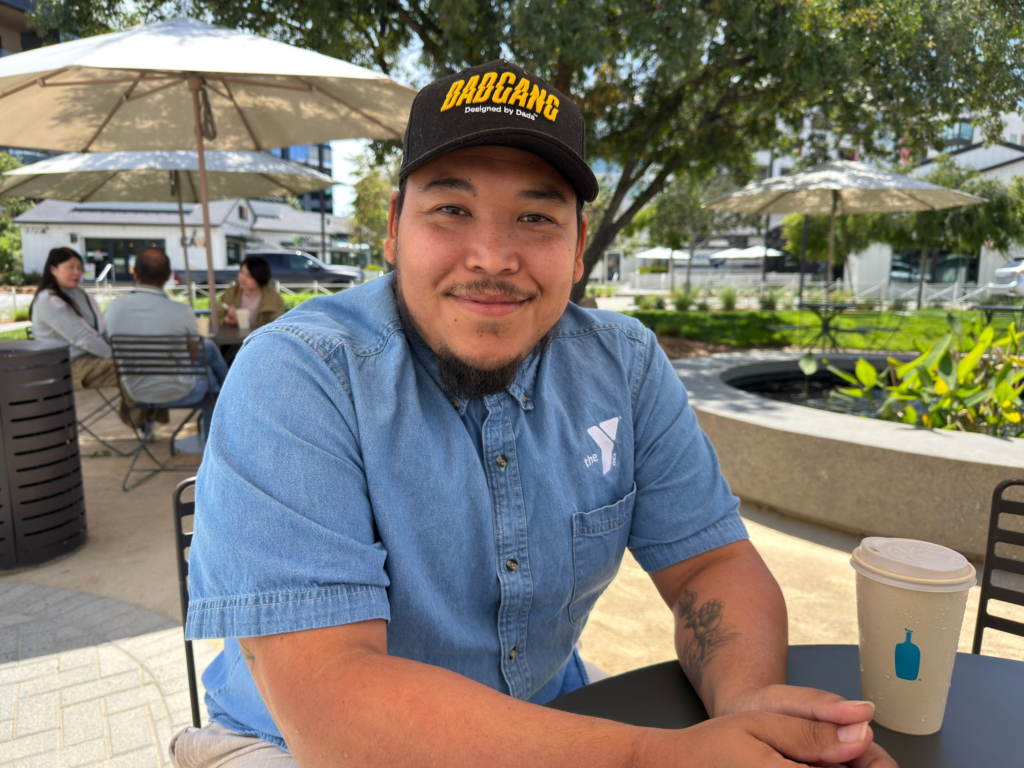
Don’t ask Brother Batie his real first name.
“Most people don’t know my government name, and I don’t share it too often,” he said. “I’m kind of like Batman.”
While many people don’t know his proper name, there are many people who do know Brother Batie.
From his entry-level job as a housing specialist with the YMCA to his current position leading a program that provides financial assistance to youths, Batie has helped countless young people stay housed and avoid homelessness.
In 2024, he was recognized as the Program Staff Member of the Year at the annual RTFH conference, and his Instagram page where he’s known as Batie the Housing Guy has hundreds of followers.
“There’s so many people who have an idea of what I do but don’t really know exactly what I do,” he said about his Instagram posts. “I wanted to really help get the word out there and build a community.”
Helping struggling youth comes naturally for Batie, who had his own challenges while growing up and sometimes couch-surfed at friends’ houses, which he said sharpened his social skills and has given him empathy with his clients.
Batie graduated from San Marcos High School in 2009 and attended CSU San Marco on a scholarship. Although he didn’t graduate, his time at CSUSM would have a life-long impact on Batie through his involvement with the fraternity Alpha Psi Rho.
“Our organizations began volunteering, doing community services,” Batie said about work he and his frat brothers took on. “The Y was one of them”
Batie credits his fraternity “big brother” Jason Vicente for inspiring and guiding him. Both would later become staff members at the YMCA.
After graduating, he took a job at a sleep-medicine company where he developed his business acumen while opening sleep centers and dealing with specialists and insurance companies.
It was a good job but not something he wanted to do long-term, and in 2019 Batie took an entry-level job at the YMCA. As a housing specialist, he helped a case manager with day-to-day tasks, built furniture and prepared rooms at an Oceanside house owned by the YMCA.
Things clicked. Batie brought both lived experience and a business sense to his new job.
“It was really cool to use both sides of my brain,” he said.
Batie created spreadsheets to track how many nights people were spending at the Oceanside house. He could forecast a budget for the staff. He suggested ways to make things run smoother and with better collaboration.
He was recognized for his work, and Batie was promoted to housing operations manager after two and a half years. By then, the YMCA had purchased a 25-bed apartment complex in Escondido for former foster youth and homeless runaways, greatly expanding the services the nonprofit offered in North County.
Last June, the federal Family & Youth Services Bureau awarded the YMCA a grant to launch the Direct Cash Transfer Program, which Batie oversees in his new position as Social Services Program Manager.
Under the demonstration grant, 18 San Diego County residents, ages 18 to 21 and in unstable housing or at risk of homelessness, were given $500 each month and access to social services for one year.
“We have a social work case manager and a support specialist who are walking alongside them in this 12-month program,” Batie said. “We provide them with financial literacy workshops, and once a month we come together as a cohort with a guest presenter covering a topic they’re interested in.”
The program will have three 18-member cohorts, and the first is in their final month. Batie said only one member has lost housing, and he’s confident all will become self-sufficient.
“Youth homelessness service is adult homelessness prevention,” Batie said. “If you prevent someone from entering youth homelessness, there’s a higher chance they will not be an adult homeless person.”
As a demonstration project that will be used to test programs, Batie said running the Direct Cash Transfer Program “is like building the ship while we’re already in the water,” but he is figuring out what works and what doesn’t.
He’s frequently in touch with all members of the two active cohorts – the third is scheduled to launch in October – and Batie is hopeful about the program’s outcome.
Working closely with cohort members, he said there are many misconceptions about young people facing homelessness, including that they are lazy and exploiting the system.
Batie said those are untrue perceptions, and he sees a little of himself in the clients he works with.
“I think if you were to hyper-zoom in on specific areas of my life, it’d be like,’ Oh, he’s not doing the right thing’ or ‘He’s on the path to trouble,’” he said. “But with guidance, support, allowing myself to make mistakes, I’m just fine now.”
So how did he get the name Brother Batie?
“I’ve been referred to as Batie since high school,” he said. “It just was a good way to have my own identity.”
The Brother part came when he was on paternity leave in March 2021 before his daughter was born. One of the papers he filled out for work asked for his preferred name, and after he wrote simply “Batie,” he learned having only one name wasn’t allowed, and the document came back as Batie Batie, or shortened as B. Batie.
Changing that moniker to Brother Batie was suggested by Jason Vicente, who likely saw the name as a perfect fit for his old frat brother.
