El Cajon releases results of first city-specific homeless count
Feb. 24
By Gary Warth
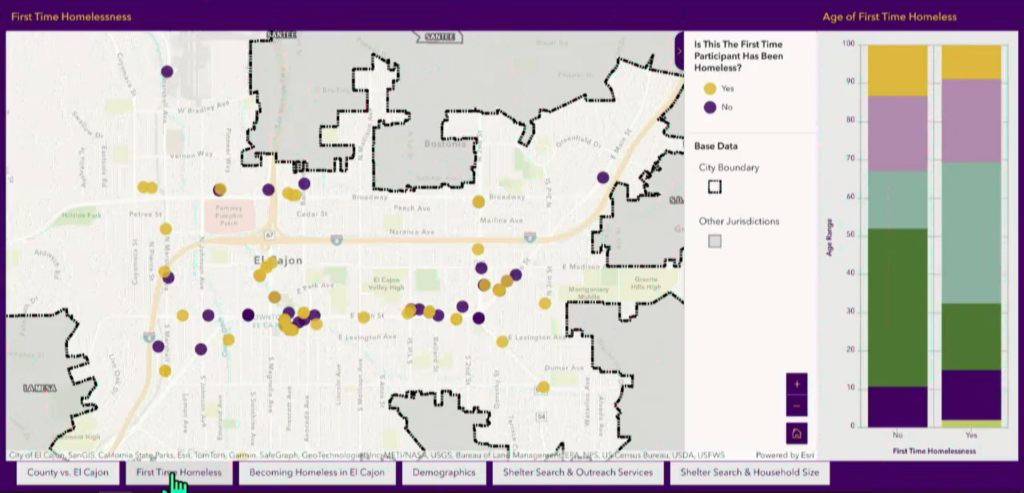
EL CAJON — Results from El Cajon’s first city-specific homeless count found that most people surveyed became homeless while living in the city, and that a majority of those experiencing homelessness for the first time were 45 or older, among other findings.
City Council members received the report at their Feb. 24 meeting and praised the effort.
“This is awesome data,” Councilmember Phil Ortiz said. “I think it’s very encouraging, and it’s going to inform us and our residents.”
In addition to counting people found living outdoors, teams that went out at 4 a.m. on Jan. 22 conducted a 45-question survey gathering information on age, health conditions and length of homelessness.
“We’re already seeing information that we’re going to pass on to Housing, Parks, the Police Department and the groups that actually work in this arena,” said El Cajon Director of Information Technology Sara Diaz. “We’ll look for insights that may change recommendations for funding, policies and procedures.”
The city-specific count was launched in part in response to the 2025 regional point-in-time count coordinated by RTFH. That report showed a 21.6% increase in unsheltered homelessness in the El Cajon area, while most other cities saw decreases.
City officials later learned the regional count included individuals in unincorporated areas outside city limits. In response, El Cajon conducted its own count focused strictly within city boundaries.
Diaz said the Jan. 22 count identified 146 unsheltered individuals within El Cajon. The 2025 RTFH count identified 344 unsheltered people in the broader El Cajon area, including roughly two dozen outside city limits. Results from the 2026 regional count have not yet been released.
“What we’re doing here is getting back to looking at these people as individuals,” Diaz said. “From that, we can better tailor services and funding.”
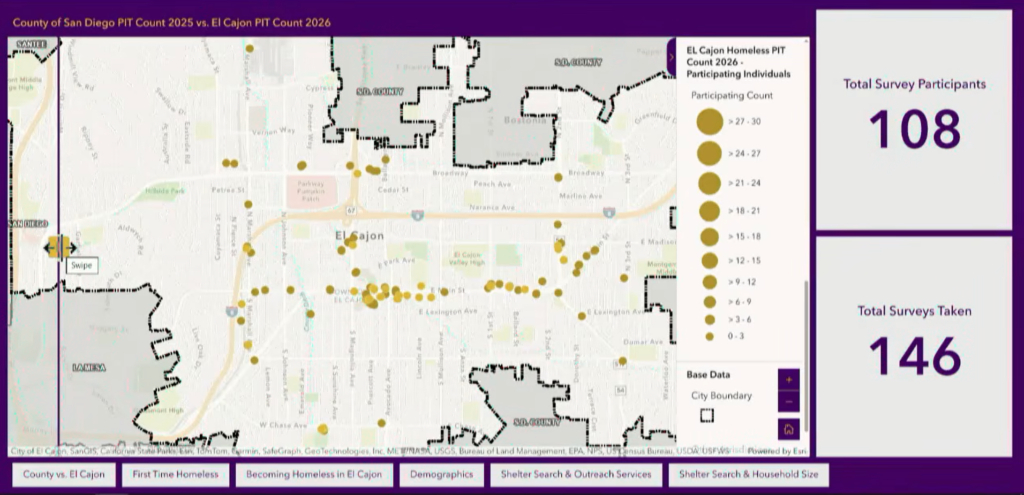
Among the findings:
- Nearly 60% of those experiencing homelessness for the first time were at least 45 years old.
- Almost 64% were living in El Cajon when they became homeless.
- Nearly 50% had been homeless for at least 36 months.
- Almost 50% reported having a mental health condition.
Diaz said one emerging insight involves gaps in service connection.
“About 26 individuals indicated they want to connect to services but have not yet done so,” she said. “That’s a gap we may want to explore.”
Three additional quarterly counts are planned this year. Diaz said the survey may be refined.
“Forty-five questions is a little much,” she said. “We’ll look at improving it, but overall it was a very successful first count.”
Councilmember Steve Goble expressed concern that maps showing clusters near service providers could suggest additional providers might attract more individuals experiencing homelessness from outside the city.
“My concern is that if we allow a growing number of homeless service providers to establish sites in El Cajon, it could become a draw from outside the city,” he said. “That stretches our compassion and our resources.”
Mayor Bill Wells suggested adding questions in future surveys, including whether respondents had previously received a county hotel voucher or been admitted to a psychiatric hospital.
Rebecca Branstetter of the East County Homeless Task Force praised the effort.
“I’m excited about the depth and quality of the data you’ve gathered on this first pass,” she said. “We stand ready to work with you to use this data to develop evidence-based solutions for El Cajon and the rest of East County.”
