El Cajon withdraws $5.3M grant application for homeless services, encampment cleanup
By Gary Warth
July 14, 2026
El Cajon has become the second area city in two months to pass on applying for millions of dollars in state funding to help homeless people because of the City Council’s perception of housing first and other issues.
The City Council voted 4-1 to withdraw their staff’s application for $5.3 million in Encampment Resolution Funds at their July 14 meeting. The application was submitted in the previous month to meet a June 30 deadline, but it had not gone before the council.
Among the reasons cited in withdrawing the application was a fear of too much state control, questions about how to store encampment items, concerns about new posting requirements and an overall rejection of the housing-first approach.
“It just feels wrong to me to adopt what I consider a tremendous failure of the state of California, the housing-first policy,” El Cajon Mayor Bill Wells said. “I can’t think of a worse public policy that California’s engaged in. So although the part of me that would love to get free money is intrigued, I think it puts handcuffs on us that they don’t like.”
Councilmember Phil Ortiz said it would not be prudent to reject the money right off the bat, but he still had concerns.
“I am very hesitant to buy into the state’s philosophy of battling homelessness,” he said. “This kind of feels like a way for the state to get more people onto their methodology.”
The comments were similar to objections raised by the Encinitas City Council on June 26 when they voted 4-1 to decline an application for a $3.9 million ERF grant.
In a presentation to the council at the July 14 meeting, El Cajon Development Services Department Housing Manager Jose Dorado said the ERF grant would span 27 months and enhance the city’s current efforts at addressing homelessness.
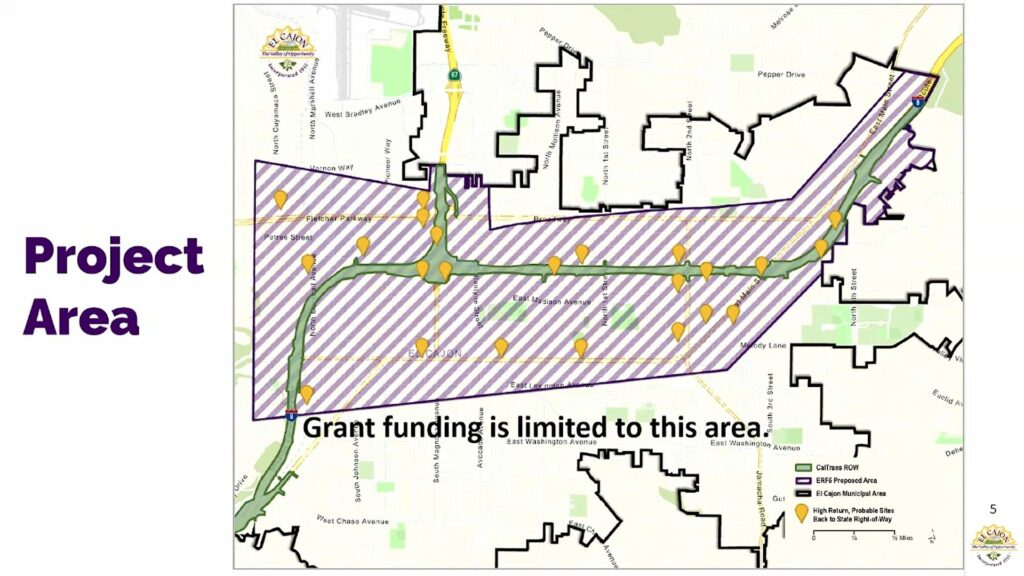
The grant application focused on outreach in a targeted area at the Interstate 8/state Route 67 corridor, and the ERF also would fund case management, behavioral health services and interim and permanent housing.
Dorado said the grant would fund services for 100 people, with 35 going into permanent housing and 30 being placed in an interim shelter.
Partners working with the city would have included Crisis House, the East County Transitional Living Center, El Cajon Police Department and existing homeless outreach services.
At the El Cajon meeting, Councilmember Gary Kendrick cast the only vote opposing the withdrawal and said the city should try for the money and hold off judgment until analyzing it more.
Councilmember Michelle Metschel suggested the city would be better off to go it alone than take state money because they already were seeing progress in reducing homeless numbers.
“If we are going to look into this grant, is it just boosting what we’re already doing?” she said.
“And yes, it’s free money,” Metschel continued. “But I think we would just be throwing money out there, and the results are not going
to speak for themselves. The results are not going to be there even though we got extra money for now.”
City Manager Graham Mitchell also questioned how effective the program would be at housing or sheltering people.
“If we had $5 million over the next two and a half years, how many more people could we get into housing?” he said. “Because remember, someone has to agree to go. Most of the cleanups that we do, 90% say, ‘I’m not interested.’ It may be even higher than that.
“And so just because you have a grant program from the state doesn’t guarantee that these folks are going to get into housing,” Mitchell said. “So that is the challenge. Is all the squeeze worth the juice, because we may get very little juice, yet we’re going to have a whole bunch of restrictions on how we currently operate.”
Wells raised similar concerns.
“Thequestion is, would $5 million injected into service providers around us change the trajectory of homelessness in El Cajon when 90% of the people say, ‘No thanks,’” he said.
Concerns raised by Wells and Mitchell were not experienced in recent local ERF projects, however. In Lemon Grove, where RTFH was the applicant for an ERF grant, almost all people contacted by outreach teams accepted housing and services.
RTFH also helped coordinate an ERF project that had similar results in Carlsbad and Oceanside.
A much-repeated criticism of housing first is that many homeless people would benefit from treatment for addiction or mental illness before being housed.
Dorado told council members that the latest ERF funding round had more flexibility than previous rounds, and people could be placed into programs before housing.
Another sticking point was an ERF requirement that housing first be used throughout the city and not just in the targeted area throughout the life of the grant.
Dorado pointed out, however, that most service providers contacted with the city already use a housing-first approach.
Another concern raised in discussions was about a requirement that the city post a notice of planned encampment clearings 48 hours in advance, which could slow down the city’s response in some cases.
