Encinitas passes on application for $4 million homeless service grant
By Gary Warth
June 25, 2026
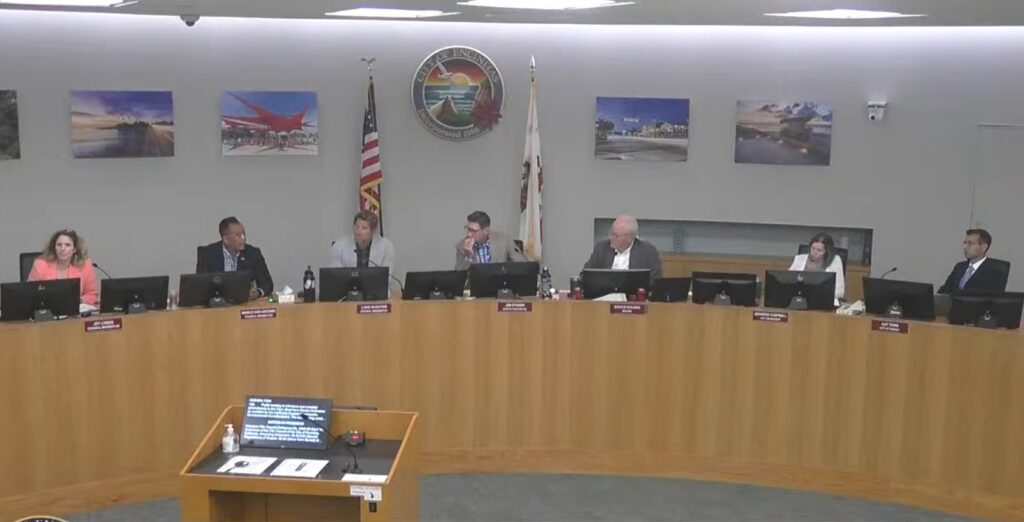
A divided Encinitas City Council has voted against applying for a state grant that could have provided services for 100 homeless people, housed 20 of the people and cleared encampments that are on or near state land.
Councilmember Joy Lyndes cast the only vote supporting the application for a $3.9 million grant from the state Encampment Resolution Fund at the June 24 meeting, which began at 6 p.m. and ended shortly after the vote was taken at 2 a.m.
ERF money has been used in the neighboring North County cities of Carlsbad, Oceanside and Vista to clear encampments and provide housing and services for homeless people, and a representative from the San Diego Rescue Mission said the funds would help their outreach work they are doing in Encinitas.
Council members who voted against the funding, however, appeared to not believe parts of their own staff member’s report or a San Diego Rescue Mission representative who said they are successfully using an ERF grant in Vista with no strings attached. Mayor Bruce Ehlers at one point said the grant would come with strings attached, “whether we admit they’re there or not.”
In declining to apply for the $3.9 million, Ehlers said his council members may have to consider going into the general fund or seeking other funding to expand homeless services.
A sticking point with the council majority was the application’s reference to housing-first.
“Housing-first in this state has failed miserably,” Councilmember Jim O’Hara said.
Ehlers repeatedly noted the references to housing-first in the funding notice, and at an earlier discussion about the application he noted the book “San Fransicko: Why Progressives Ruin Cities” by Michael Shellenberger as a source for his belief that housing-first doesn’t work.
Several academic studies, however, have found housing-first a successful model when implemented correctly. The National Library of Medicine reviewed 26 studies in the U.S. and Canada and found housing first programs decreased homelessness by 88% and improved housing stability by 41%.
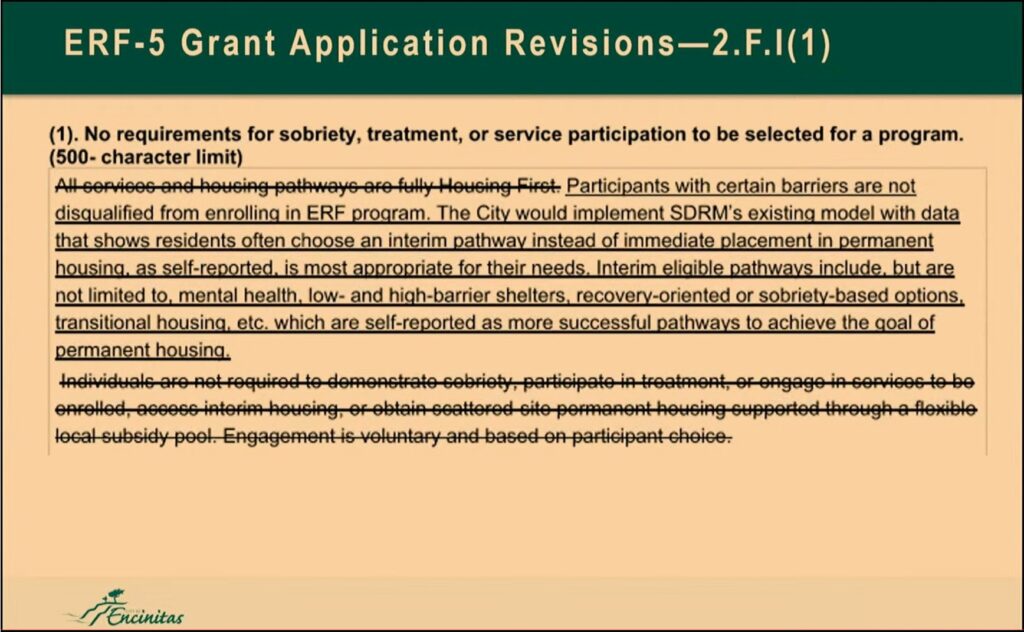
At the June 10 meeting when the application was first discussed, staff members were directed to return to the council with a revised version of the application that downplayed housing-first.
Encinitas Homeless Program Director Crystal Pugh presented the new application at the June 24 meeting and said the housing-first model has evolved significantly over the last decade.
“Housing-first is a philosophy, not a single program type,” she said.
Housing-first was introduced as an alternative to other approaches that required some type of treatment before housing. Studies have shown treatment programs were more successful in a stable environment provided by housing.
Pugh said Round 5 of the Encampment Resolution Fund application has greater flexibility than other rounds and does not require people to be placed directly into permanent housing.
“Round five enforces the city’s ability to design and manage homeless services in a way that fits local priority,” she said. “It allows the city to balance consistent client participants and community safety while continuing SDRM’s (San Diego Rescue Mission) existing model, which emphasizes program compliance, sobriety and financial stability before permanent housing.”
SDRM is contracted with the city of Vista to implement its Encampment Resolution Fund program, and Rescue Mission Chief of Staff Paul Armstrong appeared at the Encinitas meeting to describe how it is working there.
“They have complete control, and we work well with them and we’re able to, within the constructs, bring this resource that is super helpful,” Armstrong said.
Shaffer said he was somewhat swayed at hearing there were no strings attached to the grant, and he suggested applying for the money and doing more research while waiting to hear if they were awarded $3.9 million.
“That’s not chump change,” he said.
Shaffer, however, ultimately voted against applying for the grant and did not comment about his decision.
The grant would come from the California Department of Housing and Community Development, which itself appeared to be a deal-breaker for some council members.
“It still freaks me out, the HCD thing,” said Councilmember Marco San Antonio. “I understand what you’re saying, but for me, I just can’t support it.”
Ehlers asked Armstrong if the city is funding SDRM enough now to be effective, and asked how much more would they need to better address the city’s homeless issue.
Armstrong didn’t give a dollar amount but said the Encampment Resolution Fund grant would be helpful in creating more housing resources that do not exist now.
Ehlers wasn’t swayed and said the city should find another source of funding, even if it means going into their general fund.
“My challenge to the rest of the council here is, if we say no to this, there’s a likelihood we’re going to have to pony up general funds to do it,” he said. “I so distrust HCD for many other reasons than homelessness that I really have trouble going there.”
O’Hara said he was on board with the idea and again suggested there were strings attached to the state grant.
“I would say accepting money with strings attached in a way that doesn’t work isn’t the best idea,” he said. “But money spent well is worth spending. I would support that road the mayor is talking about going down.”
