Escondido boosts rental subsidies, weighs affordable housing project
By Gary Warth
March 4, 2026
ESCONDIDO — Escondido officials are significantly expanding a rental subsidy program aimed at helping low-income residents stay housed, though some residents and council members say the assistance may still fall short of rising housing costs.
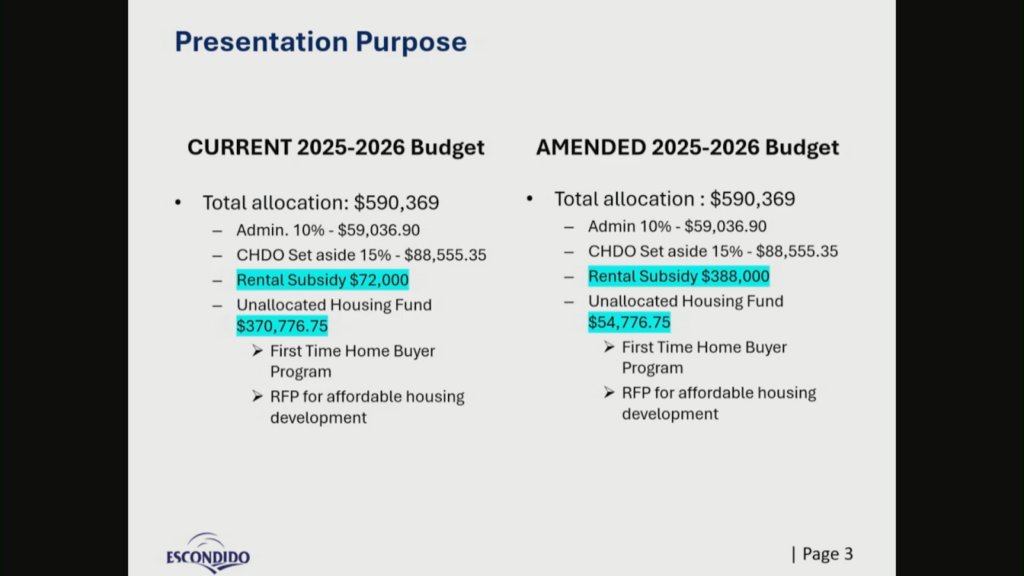
On March 4, the City Council unanimously approved increasing the program’s annual budget from $72,000 to $388,090. The change raises monthly subsidies from $200 for 30 households to up to $500 for a larger group of qualifying residents.
The original proposal called for $400 monthly subsidies for 80 households, but council members opted to increase the maximum benefit to $500 — a change that will likely reduce the total number of recipients. The final number of households to be served was not determined at the meeting.
Funding for the program comes from $590,369 Escondido received through the U.S. Department of Housing and Urban Development’s HOME program. The city also uses those funds to support first-time homebuyers and affordable housing development.
With more funding directed toward rental subsidies, the amount allocated to other housing programs dropped from $370,777 to $54,777.
Escondido Housing and Neighborhood Services Manager Danielle Lopez said the expanded program reflects feedback from residents at previous public hearings.
Other changes include opening eligibility to all ages — previously limited to those 61 and older — and removing the requirement that applicants be on a Section 8 waiting list
Subsidy amounts will be based on income. Households earning 30% of the area median income (AMI) will receive the highest level of assistance, while those at 60% AMI will receive $100 less, Lopez said.
Still, some residents questioned whether the increased subsidies would be enough.
One speaker told the council that a family of four earning 30% AMI would take home about $3,500 a month after taxes, while average rent is around $3,000 — leaving little room even with additional assistance.
Lopez acknowledged that concern, saying residents have expressed that while the subsidies may not fully close the gap, they still provide meaningful help.
Councilmember Christian Garcia requested a broader analysis of available assistance programs to better understand how much support households need to remain housed.
Councilmember Consuelo Martinez suggested surveying applicants to determine whether the subsidy meets their needs and how much additional support may be required. Lopez said those questions could be incorporated into the application process.
Separately, city staff warned that Escondido must spend $583,938 in HOME funds by Sept. 30 or risk returning the money to HUD.
The city had previously believed it had $348,000 in unspent funds, but HUD notified staff in January that the correct amount was significantly higher.
Lopez presented several options for using the funds, though most would not meet the federal deadline.
Council members expressed support for directing the funds — along with an additional $2.4 million in future HOME allocations — toward the Valley Creek Project, a proposed 136-unit affordable housing development.
The project, planned for 1.8 acres at East Valley Parkway and Fig Street, would include units designated for senior veterans experiencing or at risk of homelessness. The nonprofit National Community Renaissance (National CORE) is expected to develop the project, with a preference for Escondido residents.
Public comments on the plan will be accepted through April 3 via email to Norma.Olquin@escondido.gov or Danielle.Lopez@escondido.gov. A public hearing is tentatively scheduled for March 25.
Escondido’s expanded subsidy program reflects a broader regional effort to prevent homelessness by helping low-income residents stay housed, as cities across San Diego County grapple with rising rents and widening affordability gaps.
