For Participants, Annual Homeless Count Can Be a Meaningful, Powerful Experience

Oceanside Deputy Mayor Eric Joyce interviews a homeless woman in a channel during the Jan. 29 point-in-time count. Photo by Jordan Verdin
By Gary Warth
Jan. 29, 2026
OCEANSIDE — “Eye-opening.” “Empowering.” “Transformative.”
Those were among the words volunteers used to describe their experience participating in the annual Point-in-Time Count on Jan. 29.
“I think interacting with people directly really adds to my understanding of what they’re going through,” said Mark Kenny, one of about 60 volunteers who gathered before dawn at the El Corazon Senior Center in Oceanside, one of 58 deployment sites across San Diego County.
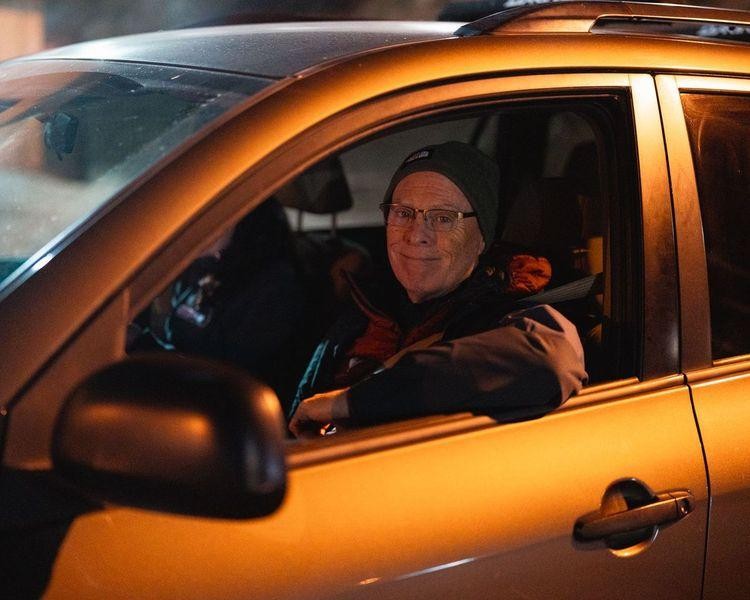
Mark Kenny pauses in an Oceanside parking lot during the Jan. 29 point-in-time count. Photo by Jordan Verdin
“I’ve talked with people experiencing homelessness many times over the years and always end up learning something,” he said, recalling the six people his team interviewed that morning. “You learn what they’re dealing with day to day.”
The Regional Task Force on Homelessness (RTFH) coordinates the Point-in-Time Count, which is required by the U.S. Department of Housing and Urban Development for jurisdictions that receive federal funding for homeless services. About 1,700 volunteers typically participate countywide. The count includes a brief survey that helps identify the demographics and needs of people experiencing homelessness.
Like Kenny, Karrie Hinkle was participating in the count for the first time. She said she signed up because she was curious about how to better support people experiencing homelessness and was looking for volunteer opportunities as she approaches retirement.

Karrie Hinkle at El Corazon Senior Center in Oceanside on the morning of the point-in-time count. Photo by Jordan Verdin
“It was a lot more positive than I thought it would be,” Hinkle said. “Almost everyone I met was open to being interviewed and taking the survey. They’re just people — everyone has struggles in life.”
The survey includes questions about mental health and substance use, and Hinkle said most people she spoke with reported no issues with either.
“Honestly, most were pretty coherent, and I believe it,” she said.
Though initially apprehensive — given the darkness and uncertainty of approaching people early in the morning — Hinkle said her fears were quickly eased.
“We didn’t encounter any negative attitudes at all,” she said. “Just a little sleepiness.”
Heather Conklin, who has participated in the count multiple times, said the experience continues to shape how she understands homelessness.
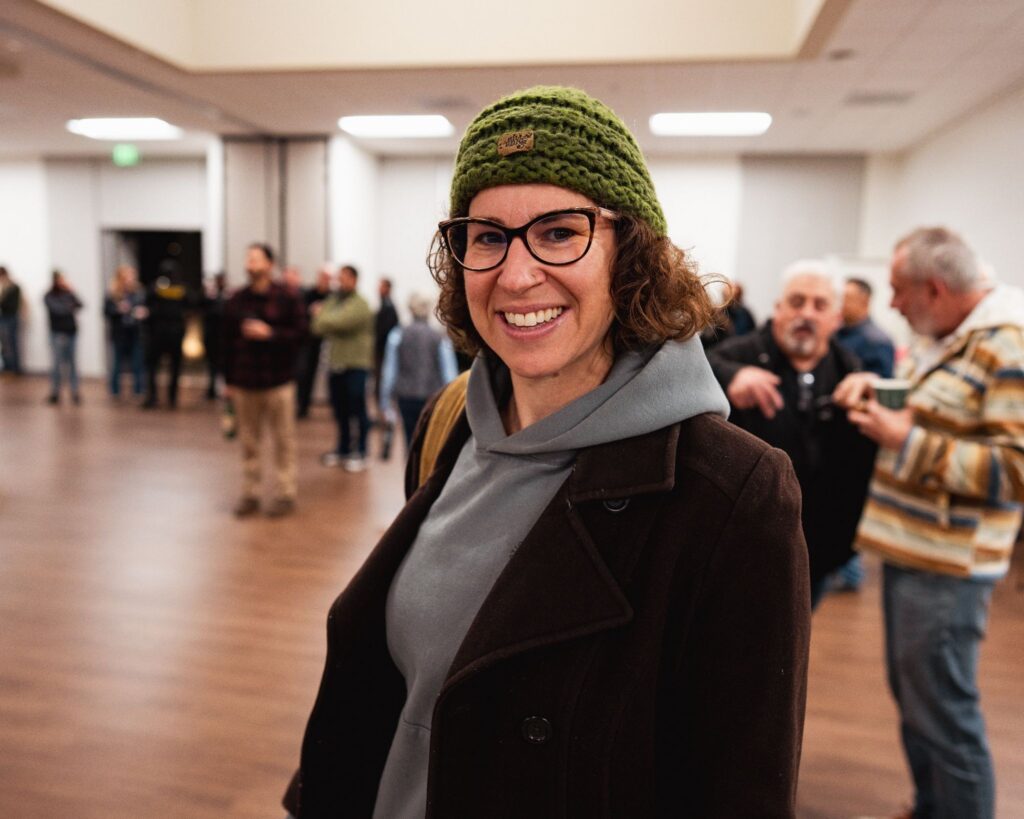
Heather Conklin at El Corazon Senior Center in Oceanside on the morning of the point-in-time count. Photo by Jordan Verdin
“It really shifted how I thought about homelessness and how I see people experiencing it,” she said.
Conklin recalled an earlier count that included one-on-one interviews over breakfast at Brother Benno’s, an Oceanside service provider.
“It allowed people to share their stories beyond the survey questions,” she said. “They provided the context for their answers, and that was incredibly valuable. It’s not the narrative you often hear in the news.”
She said that depth was present again this year.
“For those who were willing to talk longer, that context really fills in the gaps between the questions,” Conklin said. “They are humans, and they deserve to be treated with dignity and respect and to have services that support them with dignity and respect. That’s the takeaway.”
Michael Bronner, president of Dr. Bronner’s Soap, participated in last year’s count and returned again this year.
“It’s so important to have face-to-face conversations — to show love and respect and build relationships,” he said. “And of course, the data helps guide resources and identify blind spots.”
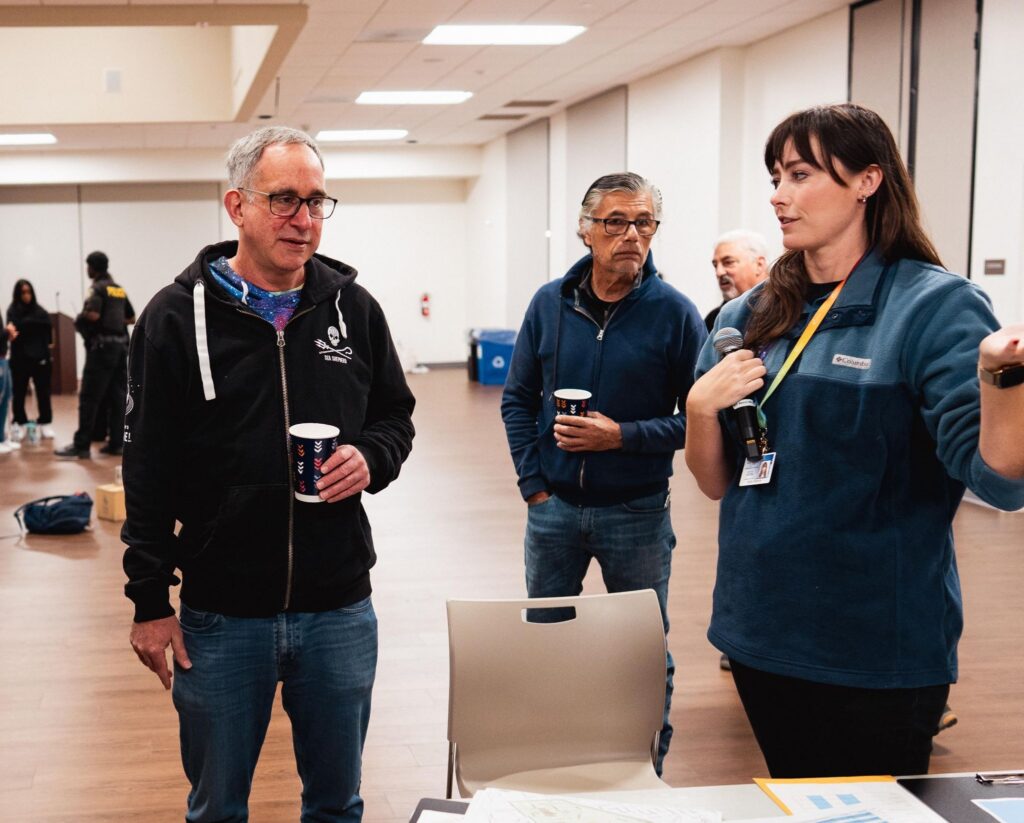
Left to right, volunteers Michael Bronner and David Flores hear instructions on how to conduct the point-in-time count from Sofia Hughes of the city of Oceanside. Photo by Jordan Verdin
Bronner said he was struck by how eager people were to talk with volunteers, even at 4 a.m.
“When people feel invisible, they’re yearning for connection,” he said.
Oceanside Deputy Mayor Eric Joyce, who has participated in seven counts, said the experience continues to challenge assumptions.
“It’s the best way to break down preconceived notions of who experiences homelessness,” Joyce said. “This could be anyone — someone who had one bad situation go wrong without a support system.”
As dawn broke, Joyce knocked on the door of a weathered Econoline RV. A 73-year-old man emerged and shared that he had been homeless for 15 years following his wife’s death. After a brief conversation and survey, Joyce handed him a gift card in thanks for his time.

Oceanside Deputy Mayor Eric Joyce speaks with a man who lives in an RV during the Jan. 29 point-in-time count. Photo by Gary Warth
Farther down a concrete channel, Joyce encountered a group sheltering under tarps and blankets. They said they had moved there after being asked to leave a more visible area.
“Talking with people helps you understand what they’re actually experiencing,” Joyce said. “You may not think you carry bias, but not understanding people’s situations creates one.”
For Kelly Dessell, the count was a first-time experience prompted by a local news segment.
“I just thought I could do something to help,” she said.

Kelly Desselle at El Corazon Senior Center in Oceanside on the morning of the point-in-time count. Photo by Jordan Verdin
She was surprised by how cooperative and friendly people were.
“I was amazed at how many veterans were out there,” Dessell said. “I would absolutely do it again.”
Patrick Gallagher, a graduate student in social work at CSU San Marcos, volunteered after hearing about the count from classmates.
“Numbers equal funding, and funding equals resources,” he said.
Gallagher said one interview became emotional when a participant spoke about mental health struggles.
“If I had a magic wand, I’d connect her to every resource available,” he said.
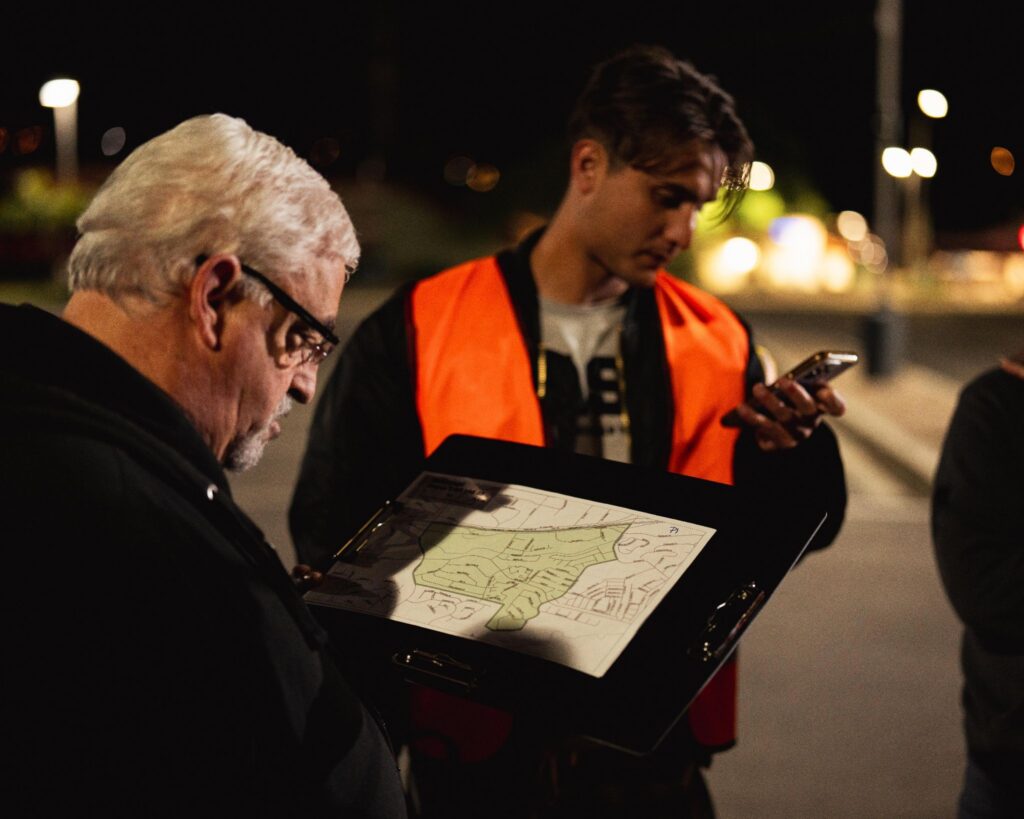
Volunteer Michael Aplikowsky examines a map while Isaiah Chavira checks his phone in the predawn hours of the Jan. 29 point-in-time count. Photo by Jordan Verdin
David Flores said he volunteered because homelessness is an issue he cares deeply about.
“Until you talk to people, you don’t understand how they got there,” Flores said. “You get the story by being on the ground doing this count.”
Jack Boger, who recently moved to Oceanside from Boston, said participating helped him reconnect with the community.
“It was empowering,” he said. “In a moment that can feel bleak, this made it feel like you can actually do something.”
Boger, who now works in housing development, said the experience reinforced why understanding homelessness matters from every perspective — community, economic, and human.
“I got emotional this morning,” he said. “Thinking, ‘There but for the grace of God, go I.’”
While the Point-in-Time Count provides a snapshot of homelessness on a single day, RTFH tracks homelessness year-round through monthly inflow and outflow reports that offer a more real-time picture of what is happening across the region.
RTFH’s most recent 12-month data shows that the homelessness response system is working: for every one person who entered homelessness for the first time during that period, one person exited the system into housing. At the same time, officials note the system remains overwhelmed due to factors such as rising housing costs, economic pressures, and limited housing supply — even as progress continues to be made every day.
The Point-in-Time Count offers a snapshot in time — but combined with year-round data and daily work across the region, it helps tell a broader story of a system making progress, one person at a time.
For many volunteers, the count becomes more than a data-gathering effort — it’s an opportunity to better understand homelessness through direct human connection.
