Harnessing the Power of Purpose
Inspiration, funding uncertainty among topics at RTFH conference
By Gary Warth
December 2025
The fourth annual RTFH conference in San Diego brought together more than 1,000 international practitioners, leaders, innovators and experts Dec. 10-11 to network, exchange ideas and draw inspiration from colleagues with a shared vision of ending homelessness.
While there were plenty of positive moments, concerns about federal funding uncertainties were the focus of some panel discussions and were frequently mentioned at the conference as cities and nonprofits nationwide brace for possible reductions and realignments.
Among the 64 sessions presented over two days were “Weather the Storm,” “WTF! (What’s the Future),” “The PHA Power Hour: Real Talk on Funding, Shortages & Solutions,” “Managing the Money: Funding Optimization Tough Times” and “Tax Considerations Following Passage of the One Big Beautiful Bill Act.”

San Diego Mayor Todd Gloria | Photo by Gary Warth
“I’m compelled to tell you all today about the storm that is brewing nationally,” San Diego Mayor Todd Gloria said in the morning of the conference’s first day.
Gloria said proposed changes to HUD funding and threats to rescind federal funding, as well as cutbacks at the state level, could reverse years of advances in homeless solutions.
Yet despite what Gloria called “tremendous chaos” at the federal level, the mayor said he remained guided by the theme of the conference, “Harnessing the Power of Purpose.”
“Our purpose is very simple,” he said. “It is to get people housed, to get people healed, and to never, ever give up on anyone, no matter how many times they may have failed.”

RTFH CEO Tamera Kohler | Photo by Gary Warth
Gloria also noted the progress that has been made in San Diego, where the city helped finance more than 2,600 affordable apartments in the last four years, with another 600 financed through a partnership with the County, the city’s Housing Commission and the state’s Home Key program.
RTFH CEO Tamera Kohler grew emotional at times when speaking about what inspired the conference’s theme.
“Last year, we saw our homeless system record some of the most significant improvements,” she said. “For every person who experienced homelessness for the first time, you housed a person.”
Kohler noted that the previous year saw just 10 people housed for every 14 people who became homeless. Among veterans, two people were housed for every one who became homeless, she said.
“So understanding the progress that we had made, this is where the theme was born,” Kohler said. “When we harness our power and the service of purpose, we don’t just make progress,” she said. “We make change inevitable.”
Kohler elaborated further on the theme.
“Let’s start with the word harnessing,” she said. “Harnessing is not accidental. It’s a deliberate act. It means taking energy, ideas and resources that might otherwise be scattered in different directions and channeling them towards a shared goal.
“Harnessing is about alignment,” she continued. “It’s about discipline. It’s about making sure our collective efforts are deliberate, targeted in the same direction with intention and focus so that we can generate emotion.”
Examining the word “power,” Kohler said it is not about a person’s title in front of a name, but is what is in that person’s heart.
“Real power is the capacity to create change,” she said. “It moves systems, influences decisions. It opens doors and it brings people with it.”
Harnessing power means making deliberate choices about where power goes and moving from intent to impact, she said.
“It means that we don’t allow fear, habit or uncertainty to sign for us,” she said. “Instead, we are actively directing our power. We are intentional about it. The resources that are attached to it toward what works. That requires courage.
“It requires us to confront what’s not working, to stop practices that drain resources without producing results, and to free up energy for new innovations or to scale proven solutions.”
Lastly, she said purpose is a target and the heart.
“The true north tells us what direction to channel our power,” Kohler said. “And it’s the deep connection that homelessness is not inevitable. It is solvable.
“Purpose reminds us that our work is not charity,” she said. “It’s justice. Purpose is what transforms our setbacks into persistence, our fatigue into determination and our disagreements into real dialogue.”
Breakout sessions on the first morning included one on a new app to find open shelter beds, workforce partnerships with homeless services, the role Federally Qualified Health Centers play in homeless prevention, preventing homeless by upstream action, multi-pronged strategies to address veteran homelessness, the role artificial intelligence can play on homelessness data and Father Joe’s Villages’ new detox facility.
Kohler moderated the session “Leadership in Action,” which featured a panel of four people who had attended a six-session program by Iain De Jong of OrgCode Consulting.
“These will be the folks that carry us across the threshold to change in San Diego,” Kohler said about the panel and the challenges they will face.
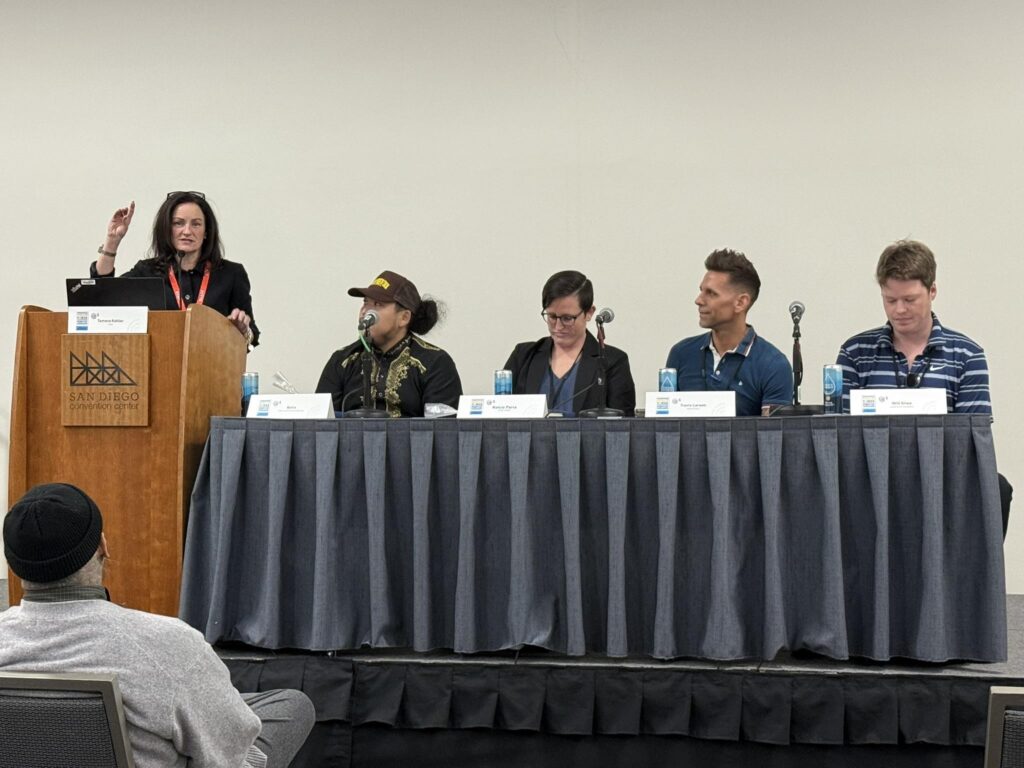
RTFH CEO Tamera Kohler moderated a panel with practitioners. | Photo by Gary Warth
“We have to be tight, committed, and driven in what we’re doing right now,” she said. “My goal and my promise to you is not only as we lean into leadership, we will rally our leadership to advocate for the funding that keeps us working.”
Panelist Kelcie Parra, executive director of Crisis House, referred to leadership as an art, science and a team sport.
“If someone is calling themselves a leader, and they’re doing it all on their own and they’re not thanking their team, and they are taking it all on themselves, that’s not leadership,” she said.
Ed Boyte, founder of The Listening Group, was the sole speaker at two sessions and on a panel at a third.
In the session “The Purposeful Pursuit,” Boyte talked about the importance of supporting healthy environments within teams and agencies, sharing stories about clients and working with people who have lived experience.
“We’re coaching, listening, working alongside people as opposed to kind of telling them what we think they need to know,” he said.
The conference’s second day included a session from Nathan Fletcher, a former state Assembly member and County Supervisor.
During his time as an elected official, Fletcher often was involved in homeless solutions, especially for veterans, as he had served in the Marine Corps.
“Tamara asked me maybe a year ago, ’Hey, would you be willing to commit into a little consulting work around homeless veterans?’” Fletcher said. “And I thought, well, that’d be interesting. That’s something I cared a lot about. I still care a lot about.”
Fletcher acknowledged that he had often met with veterans for photo ops, but had not really sat down to listen to them. This time would be different. Over several months he met with a few veterans at a time in a conference room at Veterans Village San Diego.

Nathan Fletcher | Photo by Gary Warth
“When you’re just there and there’s no pretense and there’s no judgment and there’s no need to act, just want to say, ‘Hey, how’s it going? Tell me your story, what’s working, what’s not working,’” Fletcher said. “People really open up. They share a lot, and you hear some just incredibly heartbreaking stories.”
As a result of those meetings, Fletcher said VVSD is launching a pilot program that will help veterans get union jobs.
Fletcher said he also learned how veterans need help getting VA disability benefits, which involves a complex application process. Veteran service officers now volunteer to help, but a new VVSD pilot program will pay for attorneys who are experts in handling disability claims to make the process more efficient.
RTFH’s Kohler said the conference was inspiring and it brought together so many frontline heroes at an important time. “Every year this conference was grown and this year that trend continued,” she said. “It’s heartening to see so many exceptional people come together to share ideas, discuss best practices, and support each other.”
Click below to see who was there!
