Peters, affordable housing advocates anticipate positive changes with adoption of new federal housing act
By Gary Warth
July 9, 2026
A landmark federal housing act was celebrated as a potential game-changer to address affordability and homelessness in San Diego on the eve of the bill becoming law.
“The most effective way to lower housing costs is to increase
housing supply,” Rep. Scott Peters (D-San Diego) said about H.R. 6644, the 21st Century ROAD (Renewing Opportunity in the American Dream) Act, which was passed by both the House and Senate with bipartisan support. President Trump did not sign the bill but also did not veto it, allowing the legislation to become law July 10.
Provisions in the bill include streamlines to development requirements, incentives for building affordable housing and greater flexibility for communities to invest in emergency shelters and homeless outreach.
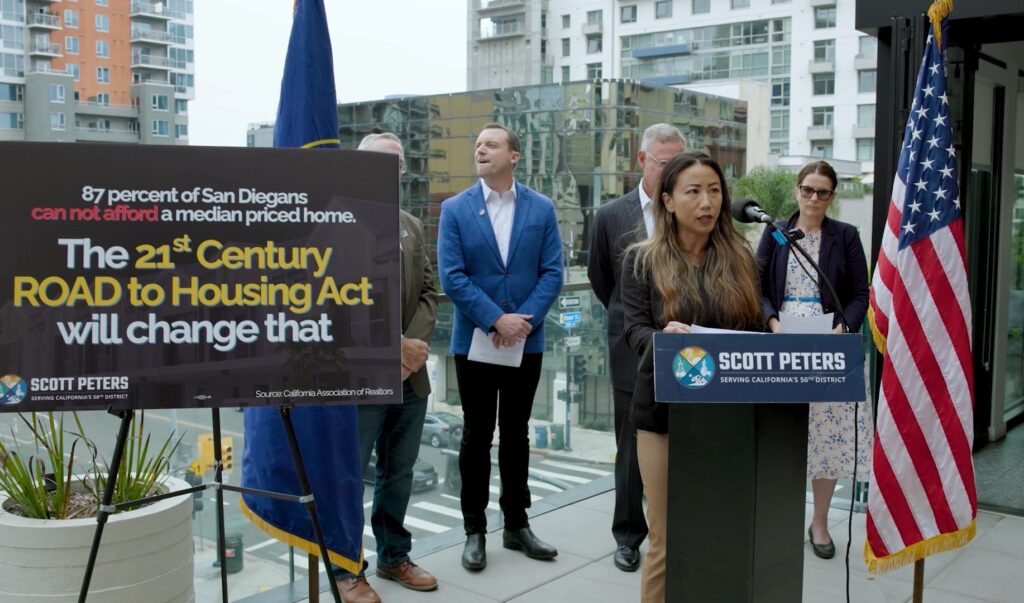
Scott was joined at the July 9 press conference by RTFH Chief Financial Officer Carolyn Yu and others at The Helm, a 78-unit affordable housing complex developed by Affirmed Housing in the Cortez Hill neighborhood of downtown San Diego.
Scott said provisions in the federal act will create opportunities to develop similar projects in San Diego, which already has made significant strides in creating affordable housing.
“San Diegois especially poised to benefit from the bill’s Innovation Fund,
which will provide competitive grants up to $10 million for local governments that are making measurable progress to make housing more affordable,” he said. “Those funds will reward cities that streamline permitting, expand ADU programs, update zoning standards and make other changes that reduce barriers to housing.”
Peters noted that San Diego has already engaged in such efforts, which resulted in the city recently dropping from the fifth most-expensive rental market in the country to the 12th.
“We’ve still got a long way to go to ensure that every person has a safe, affordable place to call home,” he said, noting that rent in the city is still 44% higher than the national average.
Peters also stressed that homelessness is a housing problem, as most unhoused people do not have chronic mental illness or substance abuse, but rather could not make monthly rental payments because of an unexpected occurrence such as a medical bill or car repair.
Carlynne Yu reiterated the observation and said the legislation will create new opportunities to make housing easier to build, easier to finance and will expand pathways to home ownership.

“From the perspective of the Regional Task Force and Homelessness, those investments are also investments in reducing homelessness,” she said. “The reality is simple. Homelessness cannot be solved without housing.”
Yu said RTFH works alongside local governments, housing providers and service organizations daily to help people move from homelessness into stable housing.
“One of our greatest challenges isn’t a lack of collaboration,” she said. “It’s a shortage of housing people can actually afford.”
“The ROAD to Housing Act helps address that challenge in meaningful ways,” she continued. “It helps prevent homelessness by preserving affordable housing, strengthening housing stability for individuals and families at risk of losing their homes and creating multiple new pathways to affordable housing.”
Besides creating greater flexibility for investing in shelters and outreach, Yu said the act also simplifies access to housing assistance for veterans with disabilities.
“This legislation is an important step because it recognizes that housing and homelessness are inseparable,” she said. “When we expand access to stable, affordable housing, we strengthen our communities and create better outcomes for everyone.”
Among the provisions in the bill is the Housing Supply Expansion Act, which was introduced by Peters to lower the cost of manufactured housing such as mobile homes by removing the permanent-chassis requirement.
“That relatively minor change will expand access to one of the most affordable forms of home ownership available,” he said.
Other major provisions in the act include financial incentive for local governments to build new housing, assistance for local governments to speed up production housing, a proposal to ensure that veterans can more easily access home loan benefits, and a push to reform the National Environmental Policy Act to make housing development more efficient.
The federal housing act does not come with funding, and local and state governments will be tasked with raising money and implementing programs to take advantage of the new legislation.
In California, voters may decide on some of that funding through Proposition 1, the Veterans and Affordable Housing Bond that will be on the November ballot.
If approved, Prop. 1 will invest $11.25 billion to expand affordable housing, supporting veterans and increasing homeownership opportunities.
Speakers at the press conference also included San Diego Housing Federation President and CEO Stephen Russell, who referred to the passage of the act an “almost a once-in-a-lifetime event.”

Russell said the act includes several provisions that will benefit Housing Federation members who work to build, preserve and support homes for lower-income San Diegans.
“It lifts the cap on the Rental Assistance Demonstration program, which allows nonprofit developers like our members to preserve and rehabilitate older affordable housing by converting them to long-term, Section 8 contracts,” he said as an example. “This has been a bottleneck in California for years, and that bottleneck just got removed.”
The act also streamlines federal environmental reviews for some housing projects, a requirement he said added months and sometimes years to affordable housing development.
Other provisions will allow Community Development Block Grants to be used for new affordable housing construction rather than just for rehabilitation, Russell added.
Brigette Browning, president and executive secretary-treasurer of the San Diego and Imperial Counties Labor Council, AFL-CIO, said the federal act will help workers in the region find affordable housing in the communities they serve.

“In San Diego, you need to make over $100,000 a year just to start thinking about buying a home,” she said. “Too many of our members are paying more than a third of their paycheck for housing. It’s not a math problem. It’s a dignity problem. It’s a survival problem.
“Housing shouldn’t be a luxury,” she said. “It should be a fundamental right for all workers in our region. This bill is a step in the right direction.”
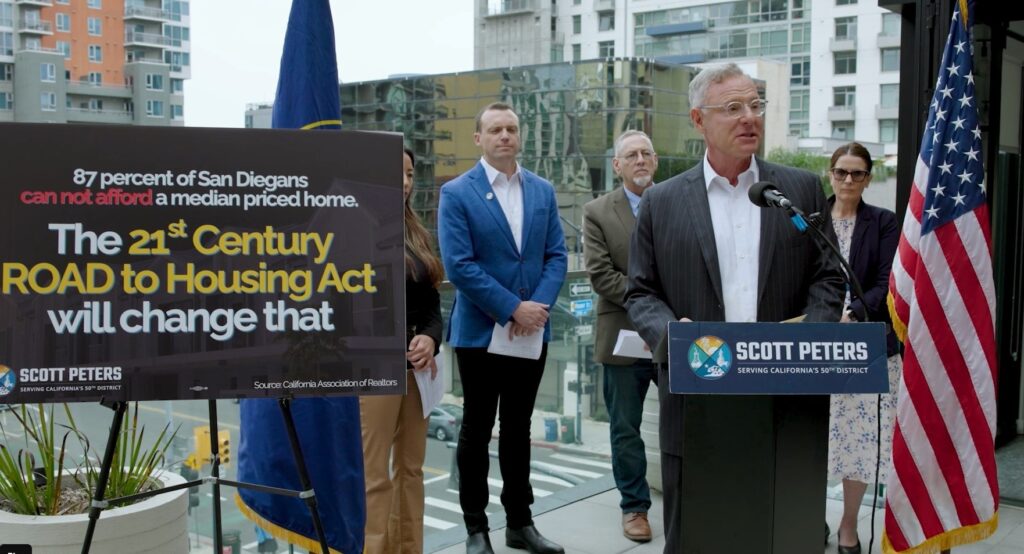
Affirmed Housing President Jimmy Silverwood said the nonprofit developer has worked for more than 30 years to change lives by creating affordable housing such as The Helm.
“We’ve seen firsthand what stable affordable housing makes possible for
families, for neighborhoods, and for the long-term health of our region,” he said. “Let’s be clear. We don’t have a demand problem in housing. We have a production problem.
“When public leadership, smart policy, and experienced developers align,
we can deliver high-quality housing that strengthens communities, supports economic growth, and reduces pressure across the entire housing system,” he continued.
“This legislation won’t solve the housing crisis overnight, but it moves us in the right direction, and it represents meaningful progress,” Silverwood said.
