Registration open for January point-in-time count

By Gary Warth
Nov. 4, 2026
It’s at an ungodly hour and chances are it will be chilly, but it’s also an eye-opening experience that could forever change a person’s perspective on their most vulnerable neighbors.
About 1,700 people throughout San Diego County each year hit the streets in predawn hours to participate in WeAllCount, the annual point-in-time count of homeless people. The next count is scheduled for 4 a.m. Jan. 28.
Registration for the count is now open at https://www.rtfhsd.org/about-coc/weallcount-pitc/. For people who want to sleep in, there are a limited number of slots available for the 6:30 p.m. count of safe parking sites, but act fast because those fill up quickly.
When registering, people can select from 43 deployment sites throughout the county, including 19 in San Diego, nine in East County, 12 in North County and three in South County. Some sites are more popular than others and also fill up quickly, so it’s advised to register early to get a preferred one.
The count is a requirement for Continuums of Care that receive funding from the U.S. Department of Housing and Urban Development, and the results are used in a formula that determines funding for the region.
Volunteers under 18 can participate with written parent or legal guardian consent by filling out the minor release form on the registration site.
What to expect
After registering and selecting a deployment site, volunteers will download the Counting Us app and study the online training materials.
Besides simply taking a headcount of people living outdoors or in vehicles, volunteers use the app to ask people they encounter a series of questions that help identify the demographic makeup of the area’s homeless population. Information from the counts is used to better understand local and national trends, plan for community needs and guide the allocation of resources.
Training material includes advice on how to approach a person and tips on how to tell if someone is living in a vehicle.
Volunteers can expect an email from the coordinator of their deployment site at least three days before the count.
Participants should arrive about 30 minutes before the 4 a.m. start to meet the site coordinator, who will assign a map of an area to cover and hand out socks and $10 gift cards. The gift cards are for people who agree to be surveyed, but the socks can be given to anyone they encounter.
People should wear good walking shoes and warm, comfortable clothes, ideally with something reflective. Volunteers also should make sure their phones are fully charged and have their site coordinator’s number saved. Some sites will have flashlights to lend, but volunteers are encouraged to bring their own.
Impactful encounters
While the survey follows a script, volunteers often have conversations with people they encounter, which many people say can be a profound experience.
“It really shifted how I thought about homelessness and how I see people experiencing it,” said Heather Conklin, who participated in the 2026 count in Oceanside last January.
Conklin had volunteered in the past and had a vivid memory of one year when she did one-on-one interviews over breakfast at the Oceanside service provider Brother Benno’s.
“It allowed people to share their stories beyond the survey questions,” she said. “They provided the context for their answers, and that was incredibly valuable. It’s not the narrative you often hear in the news.”
She said she again felt that depth of conversation at this year’s count.
“They are humans, and they deserve to be treated with dignity and respect and to have services that support them with dignity and respect,” she said. “That’s the takeaway.”
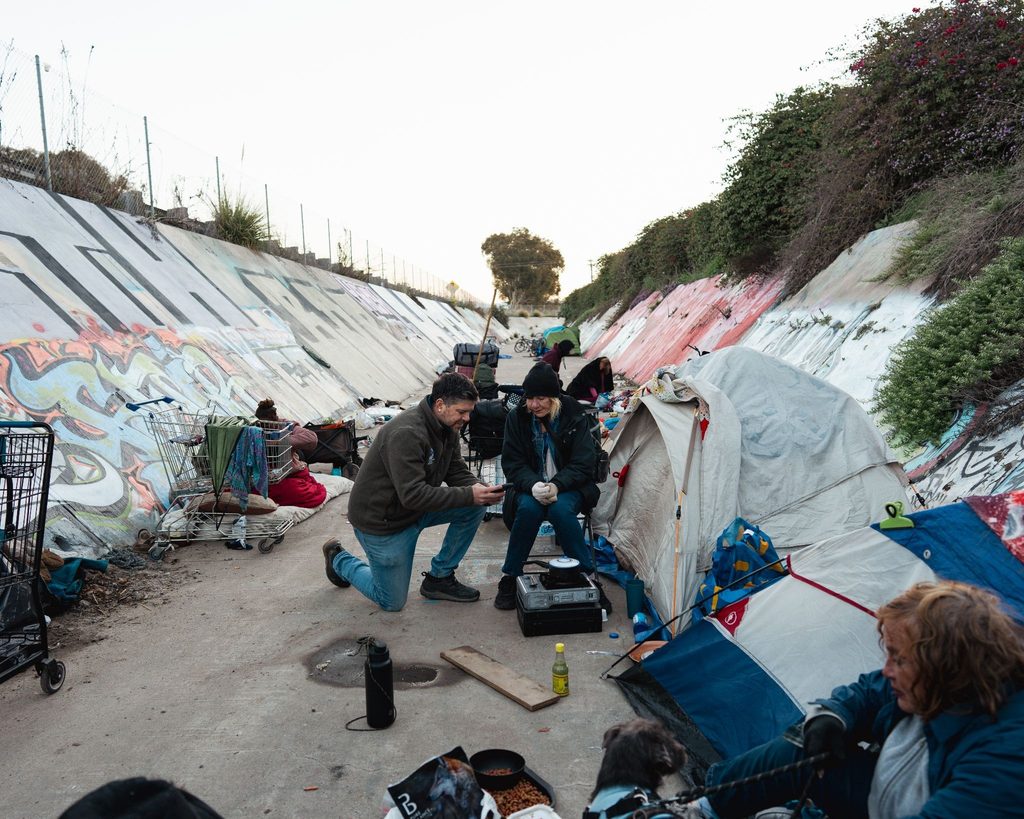
Oceanside Deputy Mayor Eric Joyce volunteered for his eighth count in January and said the experience challenges assumptions about unhoused people.
“It’s the best way to break down preconceived notions of who experiences homelessness,” he said. “This could be anyone. Someone who had one bad situation go wrong without a support system.”
Karrie Hinkle volunteered for the first time in January and said she was a bit apprehensive about approaching people in the dark during the early-morning hours, but her fears quickly eased.
“It was a lot more positive than I thought it would be,” she said. “Almost everyone I met was open to being interviewed and taking the survey. They’re just people. Everyone has struggles in life.”
Volunteer David Flores said participating in the survey helped him get a better understanding of what people are going through.
“Until you talk to people, you don’t understand how they got there,” he said. “You get the story by being on the ground doing this count.”
Volunteer Jack Boger also said participating in the count was impactful.
“It was empowering,” he said. “In a moment that can feel bleak, this made it feel like you can actually do something.”
Boger also said meeting people on the street put his own life in perspective.
“I got emotional this morning, thinking, ‘There, but for the grace of God, go I,’” he said.
