San Diego City Council hears update on Community Action Plan on Homelessness
By Gary Warth
Oct. 12, 2026
More homeless people have moved into permanent housing and fewer have returned to homelessness in San Diego in recent years, but the city is still far short of meeting its needs for more supportive housing units.
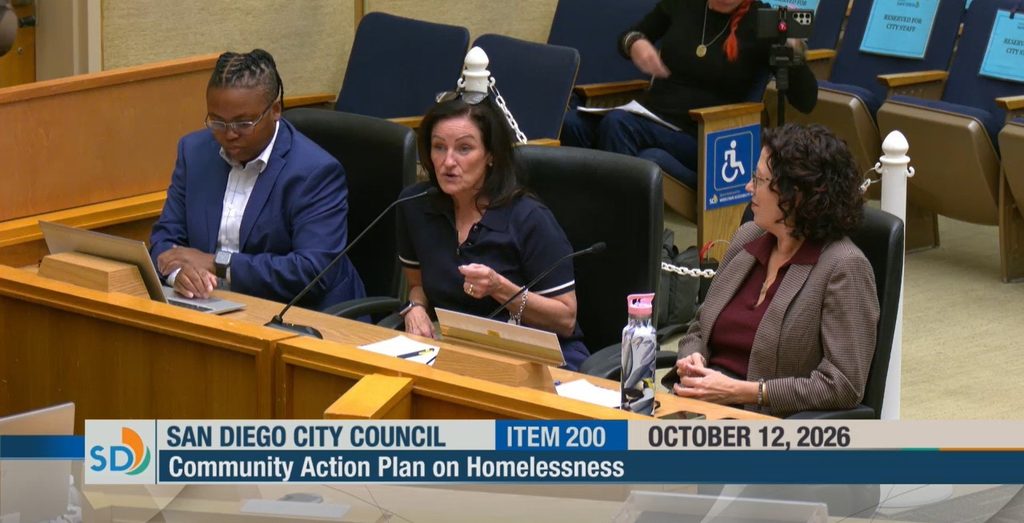
Those and other conclusions were presented to the San Diego City Council on Oct. 12 as part of a presentation on the city’s Community Action Plan on Homelessness.
RTFH President and CEO Tamera Kohler and San Diego Housing Commission President and CEO Lisa Jones joined city staff members Sarah Jarman and Casey Snell in the presentation.
Jarman, director of the Homelessness Strategies and Solutions Department, presented data that showed the number of homeless people who received services in the city had increased by 37% since 2019, rising from 10,775 in 2019 to 14,769 this year.
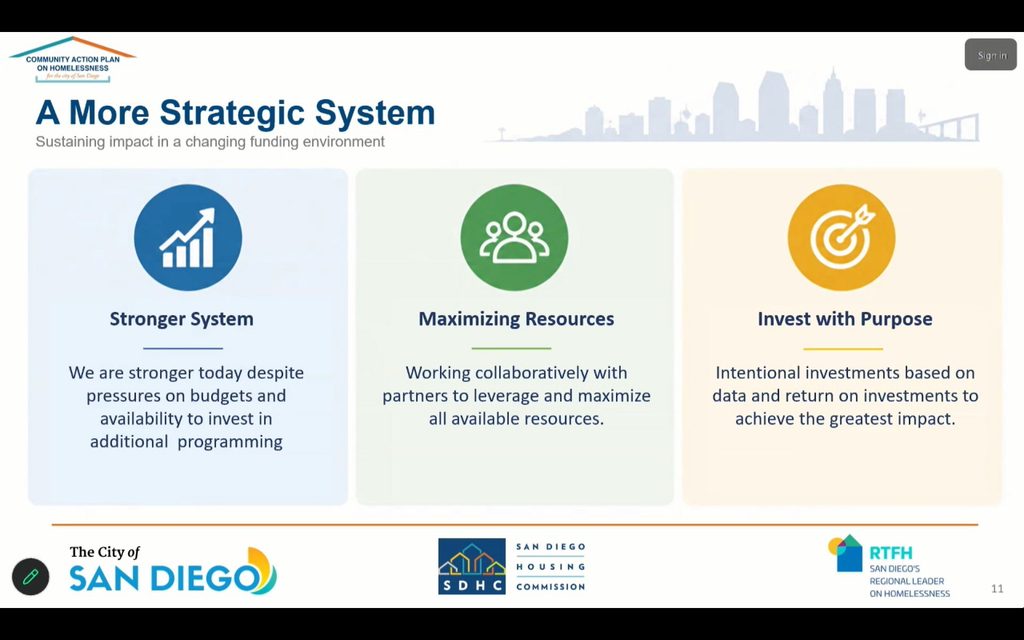
Also of note in the report was how the city had responded. Jarman said city officials had met quarterly with members of the county, service providers and people with lived experience to better understand the needs of homeless people, which led to more options for shelter, better communication and coordination, and a new focus on prevention and intervention.
“The number of beds, housing units, and services available is only one measure of progress,” she said. “We also look at how well the system works overall, how people enter and move through it, how resources are targeted, how partners coordinate, and how quickly data helps us to respond to changes. This broader view matters.
“The environment since 2019 has changed significantly,” she continued. “Demand has grown, funding has shifted, and the needs of the population have changed.”
Jarman said the 10-year plan, originally adopted seven years ago and updated in 2023, is now more data-driven and focused on the needs of clients.
“The data shows meaningful progress in some areas while also identifying that significant resource gaps still remain,” she said.
One of the significant gaps is in supportive housing. San Diego has 6,804 beds/units, but needs 3,101 more to meet its 2029 goal. In the past three years, the city has added only 419.
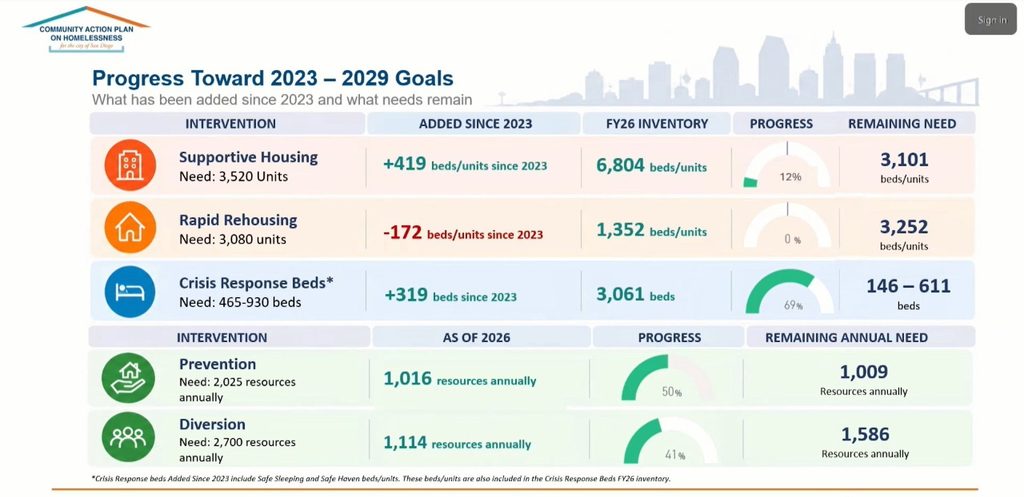
The number of rapid rehousing beds has decreased by 172 since 2023, leaving an inventory of 352 beds. San Diego needs 3,252 more of the units to meet its 2029 goal, but Jarman said the number is expected to decline next year because of a federal shift away from rapid rehousing.
The U.S. Department of Housing and Urban Development has shifted from long-term and immediate permanent housing models such as rapid rehousing toward a treatment-first approach and transitional housing.
More progress has been made with crisis response beds, which include safe-sleeping and safe-haven beds. Jarman said the city has 3,061 beds after adding 319 since 2023, reaching 69% of the plan’s goal.
The city has 1,016 homeless prevention resources, placing it at 50% of a goal of 2,025. San Diego also has 1,114 homeless diversion resources, including RTFH resolution strategies, reaching 41% of a goal of 2,700.
While some goals still are far off, a comparison with where the city was in 2019 shows progress has been made. In the past seven years, San Diego has increased its number of supportive housing units by 111%, the number of rapid rehousing units is up 54%, crisis response is up 75% and safe parking has jumped 196%.
“These figures show that despite a constriction of resources at all levels of government, the system has continued to add capacity for the last several years,” Jarman said. “The most progress has been made in diversion, crisis response and prevention, reflecting the intentional investments the system has made in these areas.”
An increase in the number of people seeking services and a lack of affordable housing has put pressure on the response system, she said.
“Not surprisingly, we’ve seen a 27% increase in the length of time of people experiencing homelessness, up from 771 days in 2019 to 980 in 2026,” she said. “It’s taken longer to secure stable housing. We are optimistic that investments in diversion and resolution strategies will improve this outcome.”
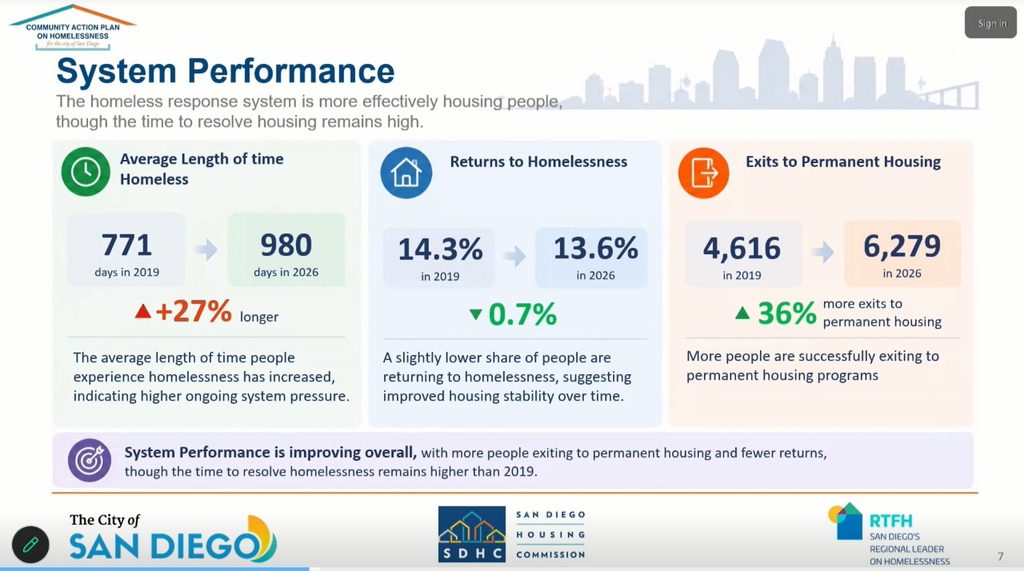
In a positive trend, the percentage of people who were housed but returned to homelessness decreased slightly from 14.3% in 2019 to 13.6% this year. Also encouraging, exits to permanent housing increased 36%, from 4,616 in 2019 to 6,279 this year.
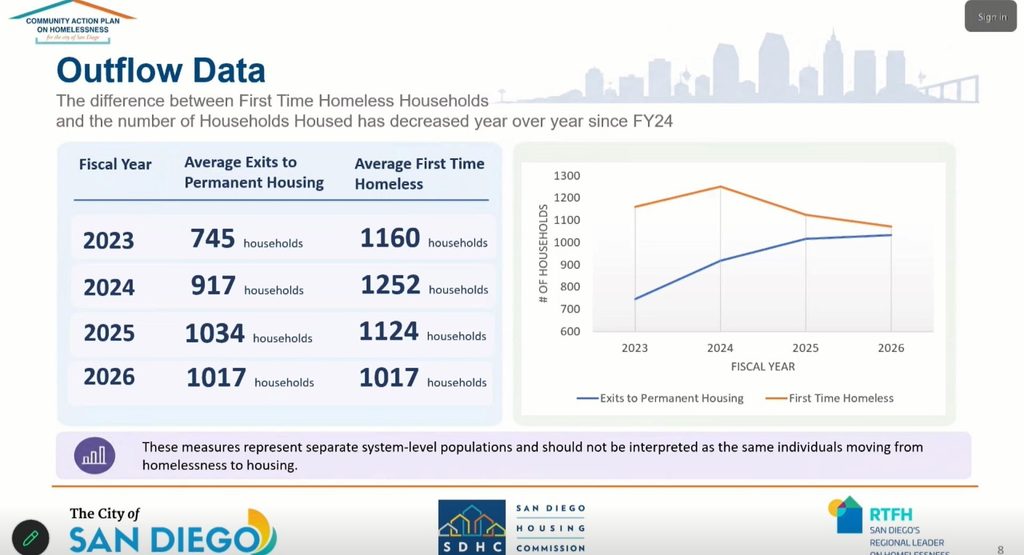
Data on outflow from homelessness to housing shows an encouraging trend, with the gap narrowing each year between the monthly number of people falling into homelessness and the number of people housed.
In 2023, the average monthly number of homeless people who moved into permanent housing was 746, and the average number of people becoming homeless was 1,160. The gap closed in 2026, with 1,017 people falling into homelessness and 1,017 moving into permanent housing.
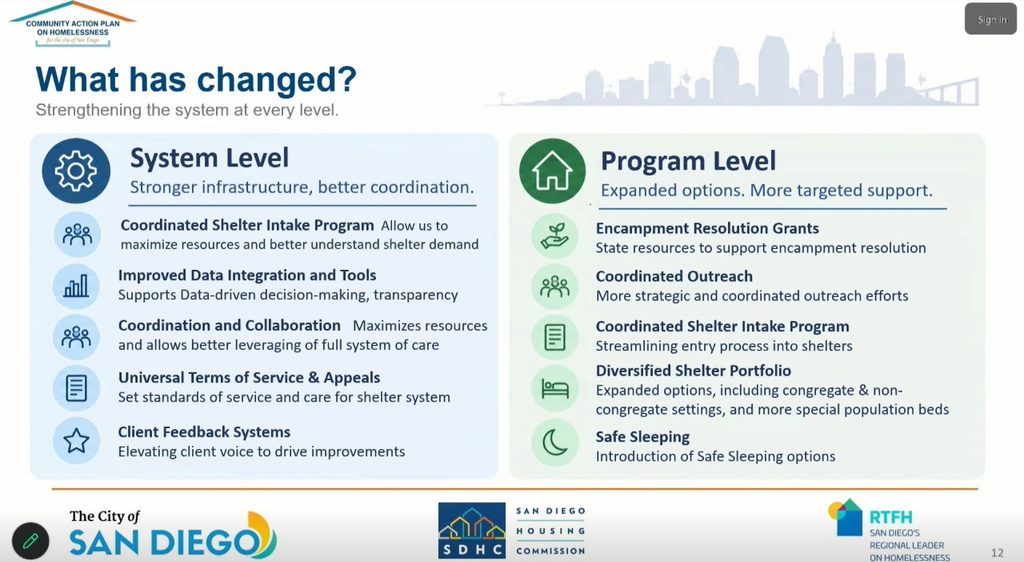
Casey Snell, the San Diego Housing Commission’s senior vice president of Homelessness and Housing Stability Initiatives, reported on what has changed in the system in the past several years.
The system has stronger infrastructure through a coordinated shelter intake program, improved data integration and tools, coordination and collaboration, universal terms of service and appeals, and client feedback systems that drive improvements, she said.
At the program level, options have been expanded with a diversified shelter portfolio that includes congregate and non-congregate settings, more special-population beds and new safe-sleeping sites, Snell said.
The San Diego Housing Commission’s coordinated street outreach also has resulted in more strategic and coordinated outreach efforts, she said.
SDHC and city officials have quarterly advisory group meetings with nonprofit leads, frontline workers and people with lived experience, which Snell said led to a more targeted strategy in the types of shelter programs the city provides.
Snell said a major component of the system’s evolution has been the expansion of data and reporting infrastructure.
“In 2019, partners had less ability to consistently see demand, outcomes and system trends across programs,” she said. “Today, multiple tools provide more timely information to support planning and decision-making.”
Snell said RTFH plays a role in providing information through its website and by regularly assessing what reporting would improve stakeholders’ ability to understand system trends.
“All of these tools led to increased transparency,” she said. The report also shows an increasing number of people facing housing instability are calling the 211 help line. About 19,000 calls about housing were made in 2025, a 30% increase from 2019, and 50% of callers were seeking referrals for housing assistance, income support and employment services, or utility assistance.
Finally, the report included data that shows the cost of prevention and diversion is considerably less than the cost of housing.
The San Diego Housing Commission’s prevention program costs $7,735 per household, and its diversion program, which diverts people away from the shelter system, costs between $2,939 and $3,269 per household. The SDHC Housing Instability and Prevention Program costs $11,132 per household.
Temporary housing provided by crisis response beds costs $17,520 to $24,496 per bed annually.
Under permanent housing, the cost of rapid rehousing units is $17,721 per household annually, including operating costs.
Permanent supportive housing costs $22,801 to $35,942 per household annually, including subsidies and services. Developing the housing costs an average of $564,953 per unit, which Snell said reflects market trends.
Kohler told council members that the city’s plan built the foundation for the regional plan, which has helped bring state Homeless Housing, Assistance and Prevention funds to San Diego, and she reflected on how the plan has evolved over the years.
“It’s important to understand how we have grown in the system in practice,” she said. “Diversion was a training and a small-funded program, and is now a critical element in addressing homelessness.”
Kohler also noted that the system has responded to needs in the city by evolving and being flexible, which led to introducing safe-sleeping sites and expanding the safe parking program.
“You don’t hit system performance measures by backing into them,” she said. “You have to intentionally fund things that will drive towards those outcomes.”
