The New Strategy: How RTFH and partners launched a state-funded effort to house people and clear encampments in Lemon Grove
ABOUT THIS SERIES: A large homeless encampment in Lemon Grove had been a sore spot in the city for years. Past efforts to clear it had been unsuccessful, and residents and business owners were growing impatient with city officials. Then in August 2025, a team of service providers and homeless practitioners moved in, backed with an $8.4 million grant from the state’s Encampment Resolution Fund. The goal was to provide housing over two years for 120 people and provide services for 170 people in all. Crews from the city of Lemon Grove, Impact Group, Crisis House, Brilliant Corners and RTFH (Regional Task Force on Homelessness), the lead applicant for the state grant, worked together over eight weeks to completely clear the encampment and find homes and wraparound services for more than 30 people. These are the stories of how it happened, who was helped, and the businesses, residents and city officials cheering on the change.
First in a series
By Gary Warth, October 2025
A New Approach Takes Shape on North Avenue
In mid August, several tables and canopies were set up on the corner of North Avenue and West Street in Lemon Grove. Crews from RTFH (Regional Task Force on Homelessness,) Crisis House, Family Health Centers of San Diego (FHCSD), Think Dignity, the Impact Group and other organizations began manning the station four days a week.
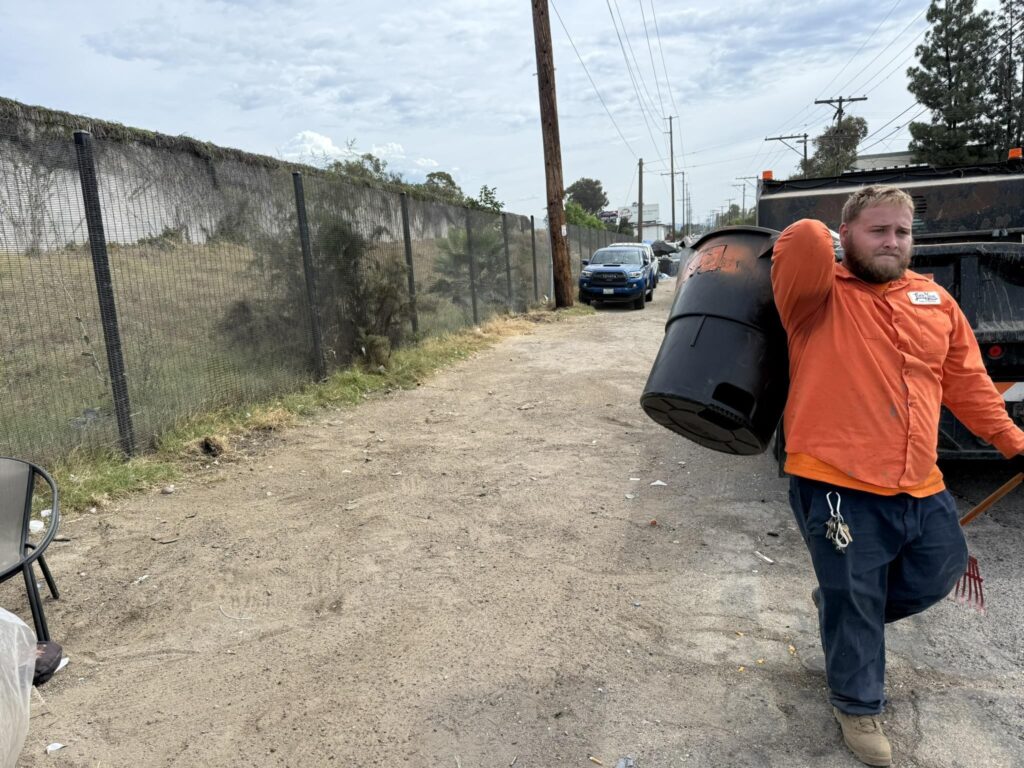
North Avenue, a rugged, neglected street with cracked asphalt and potholes, had become home for about 40 people. Battered tents and makeshift shelters lined the Street. A charred bed, tattered clothing and other discarded items were among the many piles on the side of the road. Cars slowed or swerved to avoid the many people walking up and down the street.
“There’s a lot of trash, and sometimes in the night they come to me looking for drugs, thinking I sell,” said Abraham Lopez, who has lived in an apartment on North Avenue for about six years. “This is not good.”
Past Efforts Fell Short — Until Now
City workers routinely cleaned the street, but there was only so much they could do while the encampment was active. Compounding the problem, the site had become a dumping site for residents of the community, with discarded items including a water heater that inexplicably appeared in front of someone’s tent one day in September.
The crew on the corner had their work cut out for them. Their goal was to get people off the street and directly into housing, something the city had not been able to do on its own, having little to no resources to address homelessness.
Clearing encampments is a challenge that few communities nationwide had been able to achieve. Oftentimes it involves moving people to shelter or simply moving them along, but rarely does it include moving straight to housing.
Matching someone to housing could be a months-long process, and available apartments and cooperative landlords could be scarce. Homeless veterans who receive a Veterans Affairs Supportive Housing voucher might be on their own to find an available apartment and a willing landlord within 120 days or risk losing the voucher.
But this effort would be different.
State Grant Powers a Faster, More Coordinated Strategy
Working with a two-year, $8.4 million grant from the state’s Encampment Resolution Fund, the new strategy would get people off the street and into housing at a pace heretofore rarely seen.
The model had been used in other cities and by HUD in disaster response, and it was introduced locally by The Impact Group as a way of breaking from the traditional way of clearing encampments by offering shelters or hotel vouchers and then working weeks or months to secure a unit.
“For the people who were living in this encampment, the healing can start now within the safety of their housing,” said Kris Freed, founder of The Impact Group.
“This model allows us to work quickly to end the suffering of people living in encampments, by offering them something they want: permanent housing,” she continued. “And when we have that option, people say yes.
“Working here on North Street has been a real honor,” Freed said. “Seeing folks come back from a unit viewing and say I’m ready to apply and how soon can I move in–to signing the lease and getting the key to their home, is what drives my fuel in this work. Having housed neighbors in this community to stop and say, ‘We appreciate and see the work you are doing–not for us the workers–but for their vulnerable unhoused neighbors,’ is awesome. We are so happy for all the folks that moved into their new homes and will continue to support them as they transition and stabilize. This is just the beginning here in Lemon Grove.”
Through a cooperative effort spearheaded by RTFH and in partnership with the city of Lemon Grove, the multi-pronged approach included a team that did outreach, retrieved lost documents needed to apply for housing and negotiated with landlords to accept tenants and have apartments ready in advance.
Think Dignity’s team helped people begin the work of clearing or expunging records that could be an obstacle to housing, Crisis House and FHCSD took on clients to connect them to rehab or mental health help if needed as well as employment support to lead them to a stabilized, self-sufficient life.

From Outreach to Housing: A Rapid Timeline
Crew members first hit the street Aug. 11 to create a by-name list (BNL), a real-time, person-centered list of everyone experiencing homelessness in a community, or in this case a specific encampment. It helps partners coordinate support, track progress toward housing, ensuring no one is left behind. The team identified 39 people in the first encampment.
On Aug. 18, the outreach team set up a station on the corner with tables and canopies and began talking with people on the BNL about housing opportunities.
On Sept. 3, Impact Group and members of Crisis House began driving encampment residents to view apartments that had been secured by Brilliant Corners, a group that specializes in working with landlords and is contracted with RTFH to administer the Flexible Housing Pool.
On Sept. 5, the first group of homeless people moved into apartments and the momentum continued, working to house others on the BNL before the encampment site would permanently close and be returned to the city and ultimately the community.
On Oct. 1, signs were posted that proclaimed the encampment site would close on Oct. 15. Some people from the original BNL had left the area by then, but most people on the list had been housed and the team was working on the last remaining few.
Community Frustration Turns to Momentum
The successful transformation of North Avenue happened at a time when homelessness in Lemon Grove had become a flashpoint in the city. People spoke out at public meetings and posted on social media about the city’s perceived inaction, and a recall attempt was launched against the mayor over opposition to a county shelter planned on state property within the city.
In truth, the city admittedly did not have much to show for its past attempts. With little money or resources over the years, Lemon Grove had not been able to provide housing for its homeless population, and its ordinance against camping in public often was not enforced.
“What we needed to do is take a dramatically different change in the way we approach this,” Mayor Alysson Snow said at a September City Council meeting.
Snow recalled that the city hired a local nonprofit to do homeless outreach in 2019, but funding was limited and the effort did not make a significant impact.
“They were going out and doing outreach, but we didn’t have housing to offer, and we didn’t have a lot of services to offer,” said Snow, who saw the past effort as compounding the problem. “You lose trust with people that way,” she continued. “If you come out and tease them with services and say, ‘Maybe you might get something if you just hang in there a little bit longer,’ it’s cruelty. It’s not enough. And it’s not what people need.”
Snow said the state funding will fill gaps the city has not been able to do itself and will not stop at housing.
“They’re being housed, and they’re getting the services they need,” Snow said, adding that the housing-stabilization approach is the only proven model that works.
“If they have drug-addiction problems, they’re able to go to drug rehab,” she said. “If they have severe mental health issues, they can go and get therapy. They can get the medication they need.”
‘This Program Is Not Just Outreach’ and Housing: Coordinated Community Stabilization
Daniel Sturman, encampment initiatives program manager for RTFH, has a long history as a
practitioner in homeless programs and sees the new coordinated approach as significantly more efficient than how things have been done in the past. We hope others will see this success and replicate it.
“This program is not just an outreach program,” Sturman said. “We have an outreach program,
we have a landlord engagement program, we have a housing navigation program and we have
a housing stability program all packaged into this one project.”
In the past, he elaborated, an outreach worker trying to find housing for a person on the street
might call 10 landlords to find not only a vacancy but a willing landlord.
At the Lemon Grove ERF project site, Brilliant Corners had a number of established landlords
already identified and enrolled in the program, including some who allowed people to move in
on the same day they were told they qualify for housing.
A Model for Other Cities
“I would say what makes this program different is that with this grant opportunity, we were able to package everything that we need together to move people in,” he said. “We’re not calling other agencies and saying, ‘Hey, I need your housing resources.’ We have all this stuff already together, deployed at the same time.
“From an outreach perspective, you dream of the day you can move people directly from the street into housing,” he said. “Just having everything packaged up was such a blessing.”
The Lemon Grove Encampment Resolution project is part of a growing regional strategy supported by the State of California and RTFH to end unsheltered homelessness through permanent housing solutions.
Gary Warth is RTFH’s director of communications and government affairs.
