Vista selects Interfaith Community Services to run senior rental program
By Gary Warth
Aug. 11, 2026
Vista City Council members selected Escondido-based Interfaith Community Services to lead its pilot rental subsidy program designed to help struggling seniors in the city avoid homelessness.
With seniors the fastest-growing segment of the homeless population, rental subsidies are seen as a cost-efficient way to help older people who are facing housing instability because of increases in rent and other expenses as they survive on fixed incomes.
Under the Vista Senior Tenant Assistance for Balanced Living & Expenses (STABLE)program, eligible participants will receive monthly subsidies of $250, $500, $750 or $1,000 for up to 24 months. The subsidy amount will be based on the household’s needs and will be paid directly to a landlord or service provider.
The subsidy will reduce rent to less than 60% of a household’s gross income and the program’s long-term goal is to help participants achieve stability after the subsidies end by increasing household income and decreasing expenses, according to the staff report presented at the meeting.
Council members voted 4-1 to award Interfaith the contract, with Mayor John Franklin opposed.
Discussion of the item followed a contentious exchange during the meeting, with Franklin at times raising his voice and accusing Councilmember Corinna Contreras of “acting like a child” for interrupting him. The mayor at one point suggested a motion to expel her from the room.
The discussion about the rental subsidy program was less contentious, but demonstrated a wide philosophical divide on the council.
“This is a plan of absolute socialism,” Franklin said about the subsidy program, which he predicted could balloon to millions of dollars. “The idea that we’re going to provide direct payments for people’s housing, I can’t support it on those grounds.
Franklin claimed about 10,000 people in Vista would be eligible for the subsidies under the program’s requirements.
“You don’t have enough resources here at the city to provide this to all the people who would be eligible, who would apply, who would benefit from it under the conditions you’ve set forth, so you’re going to have a very, very limited number of people who effectively win a government lottery,” he said.
Money for the program came from a year-end budget surplus, and Contreras said she recognized that the city may not always have the resources to continue the program, but also said the city should act to help its citizens while it can.
“And I happen to think that the role of government at all levels is to help protect our people here in the United States,” she said. “And you know, I wish that we had a system where everybody had health care. I wish that we had a system where everybody was treated with dignity and had a house, because housing is a human right.
“And we have so much money in this country for wars, for billionaire tax breaks, for creating
new colonial powers across the world,” she continued. “And so I’ll be damned if I don’t do everything I can at this local level to help everybody who needs it, because we can certainly afford it.”
The City Council had previously agreed to create the rental subsidy program, and the vote was to select the agency that would oversee it.
Housing and Homeless Services Division Manager Jonathan Lungpresented the item to the council and outlined ongoing programs to help homeless residents.
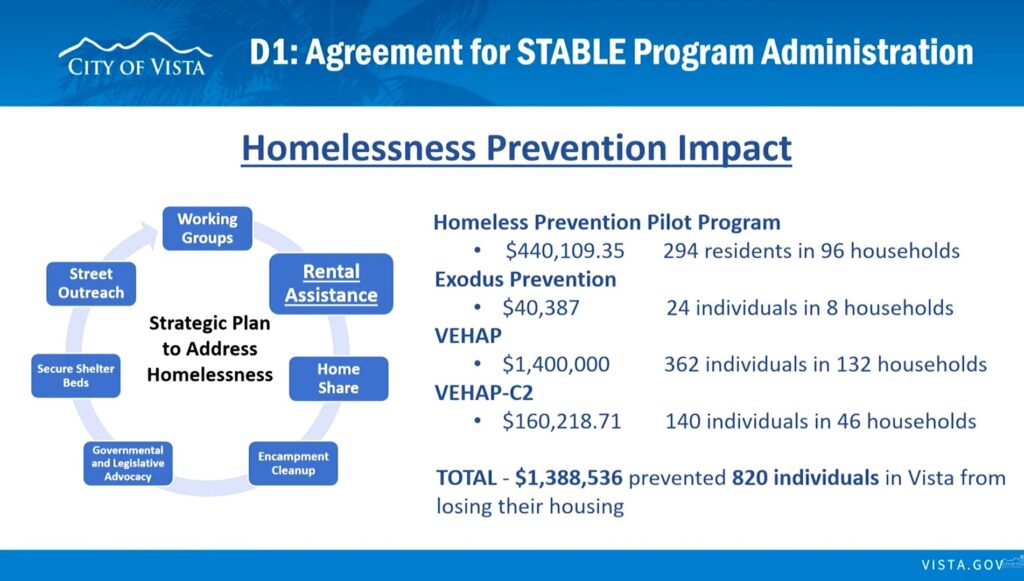
A chart presented at the Aug. 11 meeting shows details of Vista’s existing rental assistance program.
Lung said the city has offered four rental assistance programs since adopting a strategic plan to address homelessness in 2020, and the programs had provided about $1.4 million to prevent 820 Vista residents from losing their housing.
The council appropriated $500,0000 from the city’s year-end balance last November to continue rental assistance for housing and to stabilize Vista seniors, he said.
Of that money, $360,000 will assist an estimated 40 households with a monthly average of $750 each. Subsidies will be distributed over time to four cohorts that each have about 10 households.
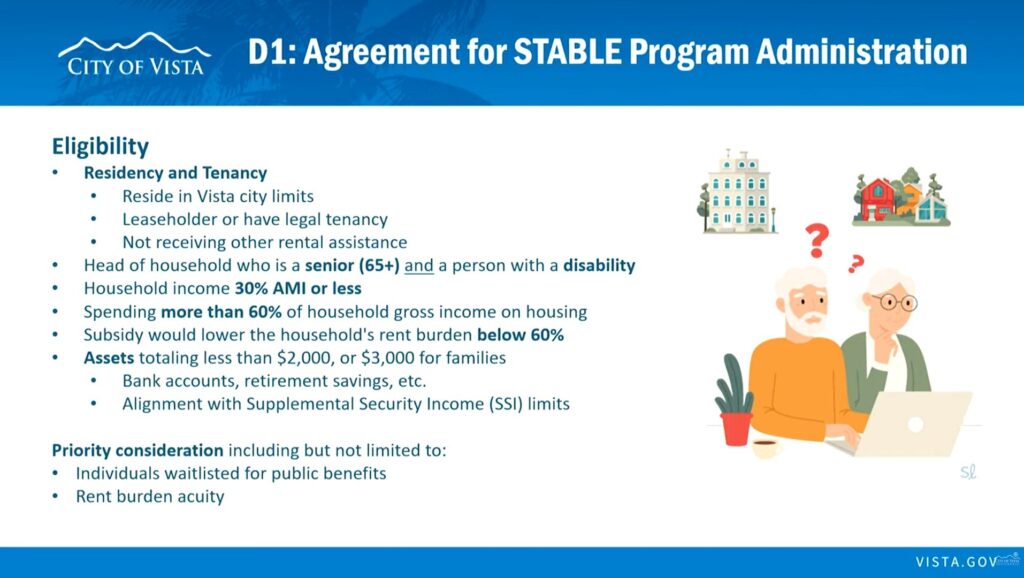
To be eligible, participants must live in Vista, receive no other rental assistance, and have a head of household at least 65 years old and with a disability. Participants also must have a household income of 30% or less of the area median income and spend more than 60% of the household’s gross income on housing.
Interfaith Community Services, which served 23,000 individuals including 4,370 seniors last year, will provide clients with an individual service plan, stabilization phase, monitoring phase, a transitioning and stepdown phase and follow-up services after exits.
Clients in the program also will be enrolled in Interfaith’s Project CARE, a safety net program for seniors and disabled people that is designed to empower individuals to remain as independent as possible in a safe environment.
Interfaith also will support participants through developing and updating housing stability plans, assistance in increasing household income through employment support, benefits enrollment, and assistance in decreasing household expenses through budgeting, utility discounts and insurance adjustments, according to the staff presentation.
The program will include landlord advocacy to manage rent increases, and Interfaith will work with Townspeople to explore shared-housing opportunities and family reunifications.
Funding will be distributed in several tranches, allowing opportunities to evaluate the program and make adjustments when needed, Lung said.
The contract with Interfaith is for 12 months with options to renew up to 36 additional months. Interfaith will report to the City Council, the Standing Committee on Homelessness, the Homelessness Commission and the Senior Citizens Affairs Commission.
Interfaith Chief Operating Officer Filipa Rios spoke to the council about the importance of programs that keep seniors housed.
“We know that once a senior becomes homeless, it is harder to get them out of homelessness,” she said, adding that homeless people can be even more costly to the city because of the emergency services they use.
Councilmember Katie Melendez, who advocated for using the budget surplus for rental assistance for seniors, also said homelessness prevention was a wise investment for the city.
“As much as we can to prevent homelessness, we will save costs down the line and reduce human suffering overall,” she said.
